There are no words that capture the weight of 2020. But what I can share after hearing from countless women throughout the year is: You. Are. Amazing!
- 1 million women consumed Gennev podcasts, webinars and articles to learn about symptoms, be supported, and get inspired.
- 100,000 of you completed the Menopause Assessment to learn about your place in the journey.
- 80,000 women joined our community to get informed, work with our menopause team of doctors and dietitians, and use products like Vitality, Magnesium and Sleep CBD to find relief for hot flashes, fatigue, sleeplessness, joint pain, and dryness.
Most of all, you did something. You took charge versus your menopause taking charge of you.
And then there is this from one of our HealthFix members, who shared it with her Gennev health coach this week…
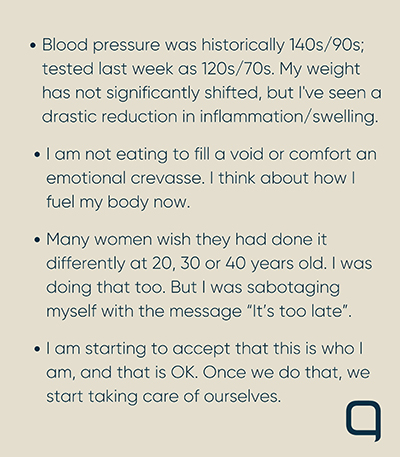
Menopause is hard, but living is in the journey.
When women commit to caring for themselves, and seeking help, they become a force that no one can hold back.
I know because I’m one of them. Like you, many members of our team are in peri/post menopause and we’re building Gennev for you from the vantage point of menopausal women”¦and we love it!
We challenge you to take care of you in the new year as however big or small that may be as you’ve got this, and we’ve got you.
Happy New Year!
Jill
Best of 2020 in Menopause
These are the 5 most read/listened to resources of the year. Enjoy!
10 Important Vitamins for Menopause Relief
Some basics of nutrition really don’t change: veggies are great, you need fat, and eating the rainbow is still a good idea. We updated our list of nutrients that are good for women in perimenopause and menopause, but the basics remain the same.
Thriving Through Menopocalypse With Amanda Thebe (podcast)
Amanda Thebe was a lifelong athlete and fitness enthusiast, but when she hit perimenopause at 43, things went … awry. Fatigue set in, and she found her previously boundless reserves of energy were drying up. And, like so many of us, she didn’t realize right away that the issues she was having were hormonal.
Supplement Savvy With Dr Wendy Ellis
We’re all looking for ways to optimize our health and especially our immunity “ things we tend to take for granted when we’re feeling good and there isn’t a pandemic going on.
Gut Health, Immunity, COVID-19, And Menopause (podcast)
One of the most unknown and underrated ways to strengthen your immune response is gut health. Science is only beginning to understand the importance of a healthy gut, including what all the gut does (a lot) and how best to protect and feed it.
Joint Pain and Menopause: Please Pass The Blueberries
Aching fingers, tight hips, sore knees “¦ joint pain is one of the most common symptoms of menopause. If you’re feeling a bit stiff and sore, especiall
It’s week four of Global Menopause Awareness Month, and we’re continuing our journey through the phases of the menopause transition with Gennev’s Menopause Types.
As we learn more from resources like our Menopause Assessment, we’re discovering there are consistencies in what many women experience. That’s how Gennev was able to develop the five Menopause Types. And women are loving having a tool that helps them understand their bodies better and be more prepared for what may be coming next.
What is Type 4?
Type 4s, that light you see actually IS the end of the tunnel, though at times you might still feel like you’re getting hit by the train. Now several years past your last period, you’re almost ready to throw away that last box of tampons under the bathroom sink, right?
As you move through the Type 4 phase, it’s time to really focus on maintaining your good health for the many happy years ahead. While your body has in many ways adapted to the lack of estrogen, there are long-term effects that require attention.
Type 4s, here are your pain points
By now, hopefully your hot flashes are either gone or clearly going. Your metabolism has likely settled into a new normal, and your weight has, more or less (no pun intended), stabilized. Anxiety, depression, irritability, rage “ those are retreating, and isn’t life more glorious because of it?
It’s good the truly acute symptoms are retreating, so now you can focus on the long-term effects estrogen withdrawal has on sexuality, bones, brain, and heart.
Vaginal symptoms
For many women, vaginal symptoms of dryness and thin, vulnerable tissue can persist for their rest of their lives. Vaginal atrophy can make it hard to want or enjoy intimacy.
Gennev’s solutions: A really good daily moisturizer and intimate lubricant can help tissues stay moister and more pliable. For women wanting to re-engage in sex who find penetration too painful, a series of vaginal dilators or sexual toys can be a huge help.
We also suggest an open dialogue with your intimate partner. Sexual problems can be very damaging to a relationship. Sexless marriage during menopause is common. So, honest conversation, perhaps with professional help, is critical.
Cardiovascular issues
While men do have more heart concerns than women prior to menopause, about 10 years post-menopause, a woman’s risk of heart disease is equal to a man’s. And because we don’t always recognize the symptoms of a heart attack in a woman, her chance of dying of it is greater.
Heart disease remains the #1 killer of women, but it doesn’t have to be. A healthy lifestyle, plus medical intervention when needed, can go a long way to managing and preventing heart disease.
Gennev’s solution: Good nutrition is vital. There are places on earth marked as “blue zones” where people live longer, healthier lives, and centenarians aren’t unusual! Most of those places eat a Mediterranean-style diet, with its emphasis on leafy greens, healthy fats, and lean proteins. Gennev’s Health Coaches are all registered dietitian nutritionists; sign up to get more information on how to eat the way spry 100-year-olds eat!
Exercise, hydration, and social time are also very important. Get your heart rate up just thirty minutes, five days a week. Drink plenty of water. And spend time with friends and family. That’s tough now, with COVID, but studies show those who maintain social relationships as they age just live longer.
Finally, consider a pet. They do the heart and body good “ taking the dog for walks, even just petting and talking to a comfy kitty can reduce stress and increase oxytocin (the “love hormone”).
Brain health
If you looked at that subhead a couple of times and thought, “Who’s Brian?” don’t panic! Brain fog is still common in Type 4, but you should be coming to the end of it soon.
All kidding aside, women do account for two out of every three diagnoses for Alzheimer’s disease, and as Dr. Lisa Mosconi and her team at Weill Cornell Alzheimer’s Prevention Clinic discovered, there does appear to be a connection between menopause, estrogen withdrawal, and development of dementia-related brain plaque.
Gennev’s solution: So how do we protect our brains? Nutrition! As Dr. Mosconi told us in our podcasts with her, nutrition is key: make sure you’re getting plenty of omega 3s (fatty fish”Dr. Mosconi particularly favors caviar), as well as fresh vegetables and fruits, healthy, unrefined oils, good glucose (not just sugar), and plenty of water. Hydration is key, says Dr. Mosconi, as 80 percent of the brain is water! Steeply reduce processed and deep-fried foods, minimize animal products, and stay well away from trans-saturated fats.
If you’re not sure you’re getting enough of any of the good nutrients (and O3s can be particularly challenging if you don’t eat fish), check out Gennev’s Vitality supplement to fill in any gaps you may have in your nutrition.
Bone health
Osteoporosis is extremely common and very dangerous. For one thing, most people don’t know they have bone loss until they experience their first fracture. And since complications from hip fractures kill more post-menopausal women than breast cancer, it’s a real concern.
Gennev’s solution: Obviously, nutrition is huge (again as are you seeing a theme here?) and fortunately, the same things that are good for your brain and heart are also good (or at least not damaging) to your bones: leafy greens, lean proteins, choosing whole foods over processed. Make sure you head to our store to grab vitamin D and Omega 3s and calcium.
Weight-bearing exercise is good for bones, so walking, running, dancing, anything that pits you against gravity is good. And while biking and swimming are great cardio exercises, they don’t help your bones, so try to get some of both. Watch your posture as well! Your body is meant to “stack” so the weight is on your skeleton (which is good for you) and not pulling muscles this way and that (which hurts).
Yes, the years after that final hot flash fades still have challenges, but being proactive and maintaining healthy lifestyle habits can go a very long way. Make an appointment to talk with one of our doctors, and get on the path to thriving through menopause and beyond!.
Some of the best years of your life are ahead of you as enjoy!
Are you a Type 4, or is there a special Type 4 woman in your life? Come join the conversation about All Things Menopause in our Community forums!
The physical and emotional changes that come with menopause can complicate intimacy or sexual health.
Sexual intercourse can become painful due to the thinning and drying of intimate tissue; libido may wane as hormones decrease and menopause symptoms increase.
But because sexuality, and in particular women’s sexuality, is such a taboo subject in American culture, we don’t talk about it. And what doesn’t get discussed, generally doesn’t get solved.
But times and attitudes are changing: there are more platforms now for women to get information and solutions and engage in conversation about the very real, very natural changes happening in their bodies.
Two companies helping women regain sexual health in menopause are Gennev and MiddlesexMD.
In this conversation, the CEOs of each company “ Jill Angelo and Dr. Barb De Pree, respectively “ and menopause-specialist OB/GYN Dr. Rebecca Dunsmoor-Su, talk about the importance of open conversation around women’s sexuality and health, the challenges of starting a business in a stigmatized niche, and the ways their companies are helping women enjoy the second half of their lives.
“
“
Transcript
Jill Angelo, Gennev CEO
All right. Well, with us today is Dr. Barb De Pree. She’s a physician and a gynecologist, and she’s been in women’s health for over 30 years, with a specialty in menopause for the last 10 years. In 2013, she was named by the North American Menopause Society as certified menopause practitioner of the year for her exceptional contributions to menopausal care, which is just an incredible feat. And so we’re, we’re so honored to have her here with us today.
Since then and even before then she has been really recognized for her outreach and communication and education of women through menopause through her women’s health platform and website called Middlesex MD and her work as the director of women’s midlife health services at Holland Hospital in Michigan. So welcome Dr. De Pree.
As well with me today is Gennev’s own chief medical officer and OB GYN Dr. Rebecca Dunsmoor-Su. So I get both of them here. She also holds a certification from the North American Menopause Society. And so I’ve got two menopause specialists with me. Welcome ladies.
Dr. Barb De Pree of Middlesex MD
Thank you for having me.
Dr. Rebecca Dunsmoor-Su, Gennev’s Chief Medical Officer
I’m glad to be here, Jill.
Jill
Good to have you both. First and foremost, thank you for what you do for women everywhere. And you know, we, we need, we need expertise in this area and it’s such a shortage as I think we all know, otherwise we wouldn’t be doing what we’re doing. So thank you. Today’s conversation, we’re going to talk about menopause. We’re going to talk about the business of supporting women in menopause. And we’re also going to talk about how women can find the resources that they need, because there is a lot of innovation happening, there’s websites like Middlesex MD, in addition to clinic settings, there’s platforms like Gennev.
And so we just want to kind of, I wanted to bring together experts who are doing this new work for women and menopause and just, and talk about it. And Rebecca is going to kind of help me drive the interview too. So you’re going to hear her asking some questions but, but with that, I’m going to just start off with with a general. Barb or Dr. De Pree, please just kind of help us understand your background and, and really what led you into the work that you’re doing today.
Dr. Barb
Yeah. Thank you, Jill, please call me Barb. So I’m a trained obstetrician gynecologist and probably about 14 or 15 years ago that organization I work with recognized that there was a need for addressing menopausal women’s health in our community, which really when you think about it is a little bit of a vision that not many places were having that many years ago. So I joined a task force, you know, they call people into joint task force, like organizations do to study the issue and find out maybe what could be be done about addressing menopausal women’s health. And so, as I learned about it, I didn’t really know at the time myself, that there were people who specialized in menopause. So it was really an interesting journey for me to understand the unmet need both. I understood that it wasn’t being met in my community. And and I was part of the problem, you know, I wasn’t well trained in menopause at the time. I was a general OB gen and generally a lot of our time and focus is on obstetrics and just, you know, spending a lot of time with OB patients and just well-women, contraception.
But so I took an acute interest in it myself. So I, after deciding yes, the community could benefit. I said, why don’t I be the person to do some additional training? So the hospital supported me in doing some training, which included the North American Menopause Society or NAMS. They do a certified program, a NCMP NAMS-certified menopause provider. So I, I did that. So it became sort of a recognized resource in the community, both a resource for patients, but other providers. I think what we’ve really recognized is that interestingly, even though a hundred percent of women will have this journey through menopause become post-menopausal, it really isn’t that much time is spent on it addressing it in a healthcare setting and internists typically aren’t that interested in it and are, you know, working on other chronic health conditions with patients, primary care, busy doing so many other things with their patients that it tended to, you know, I recognize just get kind of pushed to the side as not that important to addreess. So at any rate, I pivoted my practice away from surgical practice and OB practice, and I really have just a dedicated perimenopause menopause sexual health practice now. So primarily I’m seeing women many ages, but probably the majority of my patient population is over 40 and seeking answers.
Jill
Yeah. So many women I think are but don’t know even to ask or they’re afraid to ask. You know you know, Rebecca, why don’t you share a little bit as well, your journey into specializing into menopause too, because you know, Barb, unlike you, I think you saw a need and you started from a place as an OB GYN. I know Rebecca, you did as well.
Dr. Rebecca
I did, you know, it’s interesting. I was very lucky in that the residency where I trained had had gynecologists who did specialize in menopause. So I had some exposure to it as a specialty, and we had a very strong reproductive endocrinology department that actually still focused on endocrinology, which is the, the hormones of the female body. So I had some exposure, but as, as Barb says, you know, when you’re training in OB GYN, like there’s so much focus on OB and so much focus on surgical skill. And for the first part of my career, it was not the biggest part of my career thinking about menopause and perimenopause. I was very lucky in that my first faculty job, I, the, I was working with a vulva vaginal or, you know, that specialists who, who focused on the vulva and the vagina and disorders of the vulva and vagina.
So I gained those skills. And then as I grew in my practice, it just became obvious that this was how, how I wanted to focus my practice, basically. I feel like, you know, there are many fantastic OB GYNs who do OB and gynecology and some menopause as well. But that, for me, I felt like I could provide a service for women who maybe had slightly more complex menopause or just needed someone who had a few more tools in their toolkit. And then they could come and see me and have a place to go. It’s very much the same reason I started working with Gennev is that I wanted there to be more tools in that toolkit for women. And I was going to say, Barb, it seems like that’s probably a very much, the reason you started the website you did is adding tools to that toolkit.
Dr. Barb
The most important tools we offer patients is time and, and listening. For so many women, it’s a matter of being acknowledged that, Oh yeah, these symptoms do belong under a category of menopause and they’ve been frustrated and searching and at a loss. So I think part of the skill set of being a menopause provider is, is listening and helping women kind of understand how to bring it all together. And then obviously the treatment regimen is, is tailored to whatever those symptoms might be. But through this journey, I have an eight page intake that I have patients fill out in advance and about eight to 10 questions were around sexual health. And it was pretty astonishing to me that nearly every woman had some sexual health related concern. And for some women, it was all eight questions were, you know, somewhat bothersome to them. So and then I, as I asked more about it you know, it’s interesting when you actually ask people questions about it, you will begin to learn more about what you, what really matters to them. And what’s important for them to address and, and sexual health really came to the top of the list soon into my menopausal practice.
And then recognizing also that women didn’t recognize that there were actual expected changes that happen when they go through menopause. I think that’s not widely known. Hot flashes, I think mood, we’re understanding more about that”¦ memory, we’re hearing more about that, but sexual health still, there was a disconnect between what might help happen to them in menopause and sexual health.
So I created this website. I was also going through a master’s program at the time. I’m a masters of medical management and I’m challenged to think about a business and new business and what could you create and what was an unmet need. And for me, it was sexual health tools, devices, solutions. I didn’t have a website. I felt women could go to and have it feel like it was sort of clinically based with integrity. So I created Middlesex MD to help women have a conversation around sexual changes that occur as a result of menopause or aging or any number of things, maybe, you know, side effects of other medications, and then a small selection of things like a vibrator.
How can a vibrator actually be a helpful clinical tool? Most people aren’t thinking of it in those terms. So also want to just elevate the language around sexual health not just sex, but sexual health and how important it is that we help our patients address maintaining or attaining sexual health. And it might be something as simple as selecting the right lubricant or using a vaginal moisturizer or again, using a vibrator.
We, I sometimes will use the analogy, you know, when you turned 42 and you lost your near vision, you didn’t stop reading. You went and you got readers, so you could read. Well, if you can’t have an orgasm, does that mean you just stop? Well, no, maybe you get a device or a tool that helps you address that. So really trying to normalize the conversation around sexual health and making some simple things available to women in a, in a clinical way, was my goal with starting the website, Middlesex MD.
Dr. Rebecca
I’m glad you started to talk about how we as clinicians can help women with their their sexuality. And those changes in sexuality that come with menopause. I find that for my patients, it’s always been a really taboo subject. That there’s a lot of fear and silence and shaming, even around sexuality and the changes that can be very normal and natural as a woman moves into menopause. How do you start that conversation with women, obviously outside of the form that you have them sort of fill out, how do you have that conversation? How do you lead them down a pathway of saying this is not shameful? This is not something to be you know, this is something we should talk about.
Dr. Barb
Well, I think we have the unique opportunity of being healthcare providers and women’s health gynecologists, that it is a forum that women might expect that conversation comes up. So I think we, you know, we have the advantage of really expecting our patients to be able to dialogue about that. And it’s, it’s somewhat of a difficult conversation to have on a first encounter. So I will often recognize that, you know, patients acknowledge some concerns around sexual health and try to get a sense of how willing they are to address it at that first visit. Sometimes it really takes a couple of visits to kind of get a rapport and some trust to have it. But I, I use and emphasize the word sexual health and remind women that, you know, we care about physical health, emotional health, spiritual health, and sexual health is one of those areas that we should care about.
And we need to have language around it. We need to be able to help women understand that some of the anatomy physiology that might be interfering or causing some obstacles to enjoy sexual health and, you know, normalize it. As, you know, menopause providers, obviously we can expect most women are going to have some sexual consequences of becoming menopausal and the, what we now call genital urinary cinema menopause. And so I also, before women are menopausal and what to expect at some point, intercourse may become uncomfortable and you know, we’ll need to address that. And hopefully you’re comfortable in bringing it up. And yeah, so it’s, it’s really just repeating the message, I think about the importance of sexual health. And then I had to get the pulse of each individual as to what their comfort level is and exploring that further.
I can’t, I don’t talk about the vibrator with all of my patients on their first visit, but a lot of times, you know, you get a sense of how open somebody is and can go there right away.
Jill
By establishing Middlesex, MD and that’s M as in mouse, as in doctor. Do you find that when you do make recommendations that your patients are more apt to follow up, to try a vibrator or a lubricant or a product that you’ve recommended because you’ve also got a safe resource for them to go to and I’ll ask that question of Barb, but then Rebecca, I’d love for you to as well offer your perspective. Cause I know you’re also recommending solutions to women and how do you make them comfortable with that? So Barb, you want to start?
Barb
Yes. And I do think most women recognize the value of maintaining sexual health. And, and I put it this way if, especially in the context, now that we’re talking about menopause, we understand that natural atrophy painful sex while it’s not all atrophy, there are good reasons to have a good vulval/vaginal exam. And there are other, you know, diagnoses we have to parse out, but let’s say it is vulval atrophy. You know, the conversation is this is chronic and progressive. So I use the fork in the road. So here we are at a fork in the road and intercourse will continue to be more challenging, more painful, more difficult, or we address it, we treat it and we try some new approaches to this, whether it’s the moisturizer, the vibrator and women, while generally may have, they may have experienced some loss of drive or desire. Most women don’t want to abandon sex. They want to remain intimate within their relationship.
And when they hear that, I now need to invest in myself in some way to make this possible. Most women are going to opt in and start at that, you know, choosing the right lubricant, introducing a moisturizer. So starting at the beginning. And I think there is a lot of buy in, at least the patients I see there is a lot of buy in and you know, one of the reasons I think Rebecca, we do what we do is the reward is so, you know, people are so grateful for the successes they enjoy when they’re properly treated.
Dr. Rebecca
I completely agree. I find that I’m giving my patients permission to explore sometimes is a huge thing. You know many people were raised with some hesitance about sexuality or some hesitance about exploring their own sexuality and just saying, this is a normal and natural thing that women should do to maintain themselves and their health. Going forward is really helpful. Sometimes I also find that, you know, being able to point at resources that are not frightening, you know, a lot of pornography or, you know, sex shop type things are not designed by women for women. So really being able to say, look, here are a few places you can look that are not, that are not frightening, that are not from a male perspective. They’re actually from a female perspective, it makes a huge difference. And you know, always sort of taking that time to say, you know, these are things that I think are helpful and that I’ve looked into in think believe are actually functional and are helpful is also a really great thing to be able to give to patients.
Dr. Barb
Yeah, I and that was really my primary motivation was to create that space for women because a dozen years ago when I watched the site or so I didn’t know about a safe place to send women. So, but I do think, you know, there are so many smart, intelligent, creative women who have added immensely to this conversation now and who are making more and more resources available. So they don’t have to live in your town or my town to access. We’ve got we’ve, we’ve got a platform to all women can begin to access resources and to learn about it and find solutions.
Dr. Rebecca
Yeah, I think that’s been one of the great things I’ve seen happen over the last 10 or so years is just how the Internet has started to serve this population and how their platforms for sex therapy, their platforms for sexual aids, their platform, all there are now platforms for woman focused, dirty stories and things like that. All the things that can help with sexuality that are much more comfortable to a female population.
Dr. Barb
But it’s still, you know, still run into some obstacles in trying to market and promote the site. You know, there are certain words or statements, so we’ve, some of the social media has had to be a little bit softer, more lifestyle-related conversations rather than sexual health related, which is a little sad that you can’t use proper terms in what would seemingly be the proper context of this message. But, you know, there are still some weird standards out there that are preventing us from really getting the real message out to the, you know, our, our audiences.
Dr. Rebecca
Right. And if we’re, if we’re honest, it’s not just weird standards, it’s double standards. Cause I don’t think they’ve had much trouble promoting Viagra.
Jill
Unfortunately not, you know I was gonna kinda go there a little bit around what, how do you both drive like curiosity or in your patients? Both in clinic or if you’re doing telehealth appointments around this topic, like, you know, Barb, you said you probably don’t bring up a vibrator in every conversation right away, or you know, their relationship matters, but then also in that face to face, but then also what women are searching for you know, online for resources matters too, how do you help women be comfortable and also what would be your guidance to women who might suspect they want or need some help in this, in, in overall their sexual health as part of menopause.
Dr. Barb
That’s a really good question. And I think I’d like to think that most women have a provider in their healthcare team, that they would be comfortable asking specifically that question and could have an answer to that. A lot of the marketing I’ve done with my website has been to providers. We, so we recognize that in this space being a menopausal care provider, it it’s, you know, we’re not doing surgeries and delivering babies. It’s not a high revenue area and these conversations really take time and investment. And so a lot of providers, well, it’s not that they don’t care about it or don’t want to help their patients. They just don’t have time to. So a lot of what I’ve marketed my website is to other providers. So we know that you care about sexual health, here’s a safe place to send your patients.
So I would like to think that providers could be a resource for their patient, but of course we recognize some patients aren’t going to ever bring it up with their provider. Maybe, maybe they’re not comfortable. So it it’s been a journey of trying to be discovered and found in this space, I would say that it’s always a continual journey trying to understand. And I think it’s, it’s conversations like these that, you know, we can reach more people who say, gosh, these women sounded like really, you know, people I could relate to and they made this recommendation about this, you know, Gennev or this product. I’m going to look into that. So I think it’s just telling the story over and over and over again from trusted sources.
Dr. Rebecca
I really do agree with you. I, you know, I think in my clinic, it’s it, people are coming to me because they know I have experience and expertise in this, and that I can, I can walk this path with them. But I think there are a lot of women we found, especially at Gennev in rural situations who just aren’t have access to that provider. And that’s a lot of what drove us to put telemedicine together and to, you know, start to do this free education because we feel like, you know, there are a lot of women who just don’t have that touchstone within their community. And there are ways for us to bring the information and the help to them as well. And I think I completely agree with you that the more we promote each other, you know, I think at Gennev, we always say all boats rise. You know, if someone is doing something great, we want them to succeed. And if they succeed, we will, should only succeed more. Like this is not a competition. We really need to be helping people we think are doing something fabulous. Get that word out.
Dr. Barb
So our understanding is that every day, 6,000 women become menopausal and that there are 50 million menopausal women in America. So I think there’s enough to go around for everybody to be serving this population. And yeah, so absolutely, you know, echoing what you say, we need more providers and we need more access for patients to navigate this because you know, the impact to, to women in menopause around brain health and bone health and heart health and sexual health is enormous. I’ve been working on a project trying to help understand the economic impact of menopause and, you know, people don’t think of it in those terms. It’s more kind of a nuisance, Oh yeah. Too bad. You don’t sleep great. Well, yeah, too bad translates to how well I do my job to my, or my ability to, you know, consider promotion or my willingness to do a presentation because I know I’m not going to find the word I need when I’m in public.
I mean, this is real impact to women and their day to day function. And every woman deserves to try to address this and you know, in a safe and effective manner. And we have answers for those women. We have solutions for them, but they need an opportunity to engage.
Dr. Rebecca
Right. And I think the nice thing about there being many of us in this space who are genuinely trying to bring evidence-based information and solutions to women, is that we all have slightly different styles and every woman can find that place or that style that really works for her. And so, you know, the more of us are out there, the better who are, as long as it’s genuine evidence-based information.
What, what I owe more, I wrote a piece I think, gosh, probably about a year or so ago now called “Internet hygiene” on how do you use internet hygiene? You know, just helping women to understand, not everything on the internet is safe or verified. And it can sometimes be extremely hard to figure out which is which, but just sort of looking to see if the same information appears somewhere else where it’s not being sold or, you know, things like just their little great keys that we can give women and say, you know, that there’s a lot of great information on the internet. There’s a lot of not great information on the internet and you sorta have to, to navigate your way through, but working with people like you, we can say, okay, you trust us. Here’s another person you can trust that we feel like is doing the right thing and, and trying to bring you evidence based solutions.
Dr. Barb
You know, interestingly, I have a number of men who reach out and ask questions on my website. So there’s an opportunity for some Q and a on the website. And you know, I think the unique thing about sexual health is it involves somebody else. And so I think in healthcare we’ve to a certain extent, maybe miss the mark by not bringing along the other important people to educate them on this journey too. And so I’m always hurting to, when I get questions from men, asking really on behalf of their partner or, you know, their partner, isn’t willing to seek the answers. And I think if we can continue to engage just, you know, others who intersect with that woman we’ll, we’ll do a better job as well, and we’ll be more successful. When they’ve got the support of somebody else alongside them.
Jill
I think you know, I, I do think that is such a relevant point around the support system for women and, and Barb, I especially love that you’re doing additional work around the economic impact of not better supporting women whether it’s in the workplace or whether it’s us as consumers or it’s us as moms, or, you know, there’s, there is an economic impact of not supporting women in menopause and the research and the work’s never been done there. I know as a company who serves them, we often look at you know, how much, how much do they seek out in terms of care every year, you know, and how can we better support that? And I think that we don’t even know to what extent women are spending on trial and error, different kinds of solutions and services to try to get the help they need.
And I think Rebecca, to your point, that’s where they end up in some non evidence-based options that aren’t really helpful. They’re just something that someone has tried and either they’re trying to make a business of it or it worked for them. How, how do you both address women when they bring to you solutions? Because they’re all doing, we’re all doing our research and our diligence around areas of suffering in our lives. If they bring something to you that you might not support or agree with, or it doesn’t align, like how do you, how do you help them through that? Because we, we get it a lot at Gennev. And and I just think it’s something that, you know, we don’t want to make women feel uncomfortable in their due diligence and research either. And yet we want to get them to the right solution.
Dr. Barb
So I was at a meeting that was put on by Mayo clinic probably about a year and a half ago now. And they had an integrative physician presenting on the topic and it was it was around it was actually a breast cancer meeting and addressing, but it was around wellness and prevention and talking about, you know, mindfulness and acupuncture and yoga. And so I asked a question, I went to the podium and asked a question about a specific supplement that a number of my patients were asking me about it was, you know, kind of the latest, greatest Facebook, you know, buy this and it’ll do that for you. And I asked this woman about it. And her comment to me, which I have repeated over and over again, is there are over 800,000 nutritional supplements in the United States right now that people have access to and virtually none of them have much evidence to suggest that they do what the label says it’s gonna do.
And as providers, we just can’t begin to wrap our head around that. We can’t know all of those. So, you know, people bring in their bags and, you know, bring up their labels. Oh, you know, you probably have heard of this. It’s like, no, I’ve not heard of any of that because I don’t have a memory that can keep the 800,000 supplements that are out there. So I usually say, you know, this is a real area that opportunistic people look for an opportunity to sell there wares; we don’t have much evidence on a, B or C, just because it’s not required. So I don’t have evidence to say it’s harmful either. And I typically encourage people to do supplements and, you know, if it works great our placebo effect in, in healthcare is around 30%. So I’m supporting women to try things.
Again, I don’t think we see many of them as harmful. I just, I use the analogy that you know, the reason you’re having multiple symptoms typically in my day, it’s, it’s a hormonal issue. So when there are six bothersome symptoms that result from menopause or the absence of hormones, the thing that most often is going to restore your quality of life is probably going to be around hormones. On the other hand, I do think we need to take this opportunity to talk, talk to women about lifestyle and stress management and sleep and nutrition and diet. But I just try to say, you know, it, it’s a really, really vast industry of looking for alternative solutions. And I don’t want to say that they don’t work. Did it work for you and most people who are seeking my care are there because whatever they’ve tried, hasn’t worked and they’re looking for additional solutions.
So I can’t say that’s a hard conversation to have, but I also don’t want to feel like I’ve got a corner on all knowledge and that there is nothing out there that might not help them, because I don’t believe that. I think there are things out there that certainly can help individuals. And I’m not gonna necessarily deny them that possibility of having a successful treatment option that I may be not aware of.
Dr. Rebecca
I think Jill knows how I feel about the subject. We talk about it a lot at Gennev and we approach it very much the same way you do. We can’t possibly know about everything. And a lot of the alternative supplements and herbals and acupuncture just aren’t studied in the same way that we expect evidence for a medication. So you’re right. We can’t say that we know whether or not it works.
My big criteria that I give to patients are, do you know, it’s not harmful? Because if it’s not harmful, there’s no harm in trying it and it might work for you. I completely agree with the placebo effect and it’s, and as I tell my patients, the placebo effect works, even if you know, it’s a placebo and that’s great because if you feel better, I don’t care if it’s a placebo. Great. You’re better. So criteria number one is, is it not harmful. I say, you know, if you’re trying to evaluate for yourself whether or not this might work, what do they claim it does? Does it cure everything? Cause nothing cures, everything, you know? So if it’s supposed to fix everything at once, it’s probably not really going to do that. And like you said, yeah. And I talked to them about the fact that, you know, they’re, they’re dealing with a hormonal issue and many of my patients choose to take hormones, but many can’t for whatever reason.
And then we really explore all these other options. And I said, look, there are all these things out there. Why don’t you look around and see what seems to make sense to you and come back and talk to me about it. I can tell you if I know of any harm and we’ll go from there.
If you have ever experienced electric shock sensations, it can be quite scary. Women have described it as feeling like a rubber band snapping on your skin, a zing of electricity shooting through you, or as serious as a jolt likened to a taser. Electric shock sensations, or ESS, aren’t typically attributed to perimenopause. And for most, ESS is generally harmless and short-lived, but for some it has been the signal of an imminent hot flash.
Electric shock sensations: What’s happening?
It’s not exactly clear what’s going on, but these zaps could be related to aging, or possibly fluctuating hormones. Estrogen works with your central nervous system to send messages along nerves to the brain. When your hormones start to go haywire, signals may get crossed, amplified, short-circuited, or otherwise distorted, causing the sensation of a shock or tingling all over your body or elsewhere.
Some medications, particularly those prescribed for hot flashes, may also contribute to the sensations. Anxiety may increase the likelihood and severity of ESS.
While ESS won’t harm you, it may disrupt sleep and increased anxiety, creating a vicious cycle. In some cases, it may be a symptom of a more serious condition.
What to do about electric shock sensations
Since hormones and anxiety seem to be triggers for ESS, reining both in may be your best defense. Here are some options.
Eat more phytoestrogens. These compounds occur naturally in foods like soybeans, tofu, chickpeas, flax seeds, broccoli, berries, wheat bran, and green and black tea, and act like estrogen in the body. The addition of dietary estrogen may level out the hormone dips that are implicated in many perimenopausal symptoms. An analysis of multiple studies found that they can provide some relief from hot flashes and vaginal dryness.
Get stuck. While acupuncture can sometimes cause electric shock sensations, this ancient Chinese practice has been found to help ease anxiety and hot flashes and improve sleep and quality of life for perimenopausal and menopausal women.
Consider hormone replacement therapy (HRT). If symptoms are disrupting your life, it’s worth talking to your doctor about HRT. The goal is to provide some additional hormones to attenuate the drop in your levels and minimize the accompanying unwanted symptoms.
Get your B vitamin levels checked. Low levels of B12 may actually cause those annoying electric jolts.
Learn to relax. Pick what works for you”yoga, soaking in the bathtub, deep breathing, meditation, a walk in nature. The effect will be less anxiety, which may turn down the voltage on electric shocks.
And, like so many other menopause symptoms, ESS may respond to overall healthy habits, such as:
- Drinking more water. When you’re properly hydrated, all systems in your body perform better.
- Getting moving. Exercise boosts your mood to help you cope with the emotional side of perimenopause. It also reduces stress and anxiety, which may help alleviate ESS.
- Practicing good sleep habits. A lack of sleep can adversely affect all body systems, increasing your risk for a host of health issues, such as heart disease and obesity, and likely amplifying any perimenopausal symptoms you are experiencing.
- Curbing caffeine. It stimulates your nervous system which may contribute to ESS.
- Cutting out alcohol and nicotine. They can lead to nerve damage that may result in ESS.
- Eating right. Make sure you’re getting the right nutrients in the proper amounts, so your body works right, rests well, and heals correctly. Nutrients like omega 3s found in fish, nuts, seeds, and plant oils such as flaxseed, soy, and canola, and magnesium, found in legumes, nuts, seeds, whole grains, and green leafy vegetables, are important for a healthy functioning nervous system.
- Considering supplements. If you worry you may not be getting the nutrients you need, a supplement may help reduce ESS and other symptoms and support your overall health.
When to get help with electric shock sensations
As with all new and unexplained symptoms, it’s a good idea to consult with a doctor to rule out other possible causes.
If you have shock sensations down your leg, it could be related to a herniated disc or spinal stenosis. Diabetic peripheral neuropathy can cause shooting pain sensations in the legs and feet. Osteoporosis of the spine increases your risk of experiencing ESS, so you may want to talk with your doctor about a bone density test. Dysesthesia, or abnormal sensations, related to multiple sclerosis can be confused with ESS, but it is usually more painful.
So, before you chalk it up to menopause, consult with your physician or a Gennev doctor. Our menopause specialists can help you understand electric shock sensations as they may relate to menopause, plus discuss your symptoms and their impact on your overall health and wellness.
The information on the Gennev site is never meant to replace the care of a qualified medical professional. Hormonal shifts throughout menopause can prompt a lot of changes in your body, and simply assuming something is “just menopause” can leave you vulnerable to other possible causes. Always consult with your physician or schedule an appointment with one of Gennev’s telemedicine doctors before beginning any new treatment or therapy.