Are you allocating any of your flexible spending account (FSA) funds toward menopause symptom relief? This post is a reminder to set up appointments in order to use all of your benefits before the year turns over. It’ll be the New Year before we know it.
What is FSA?
FSA is an arrangement through your employer that lets you pay for many out-of-pocket medical expenses with tax-free dollars. Allowed expenses include insurance copayments and deductibles, qualified prescription drugs, insulin, and medical devices. You may have access to a flexible spending account (FSA) through your group health plan such as an HMO or PPO. In most cases, these pre-tax benefits are lost if not used before the start of a new calendar year.
Gina was reviewing her pay stub from work when two things happened: 1. Another hot flash revved and rolled through her body (it had to be the 6th or 7th that day already) and 2. She saw 3 letters jump out at her on her stub…”¯FSA. She blotted her upper chest and neck with a tissue and thought, “Why not use some of my flexible spending account dollars to get some relief from these [expletive] hot flashes?””¯ What a great idea! Put those saved, pre-tax dollars to work especially if you’re experiencing an onslaught of perimenopause symptoms.
Timing is everything when using FSA
Book appointments now (or get referrals) to get in to see new practitioners before the New Year turns over. Use your FSA dollars on the health-related appointments and treatments you need. And if there are a few dollars still in your account that are un-attributed, consider trying a form of care you’ve been curious about.
Non-invasive options for menopause care
For now, let’s take a look at some of the alternative, non-invasive types of health care that may be covered in your health care plan.
Integrated Menopause Care
No more grinning and bearing the symptoms of menopause, book an appointment with Gennev’s integrated menopause care team. Gennev patients find relief from symptoms ranging from vaginal dryness and pain, loss of libido, hot flashes and night sweats, brain fog and moodiness, sleep disruptions, urinary symptoms and more. With a letter of medical necessity from Gennev providers, coverage for appointments, supplements and lubricants are included on most plans.
Chiropractic
Spinal alignment with gentle, corrective, chiropractic care can relax the autonomic nerves, which can aid in”¯improving sleep, decreasing”¯stress, and increasing overall vitality. Some find that headaches are also reduced when chiropractic care is conducted.
Massage
Relaxing and gentle, a massage can soothe frayed nerves, improve overall well-being, and aid in stress-reduction, while providing some quiet, restful time on the table.
Massage pairs well with other types of care listed here, as well as with more standard Western medicine.
Acupuncture
Even if you’re nervous about needles, you might be pleasantly surprised by acupuncture. This kind of care can treat and reduce multiple symptoms at the same time in one session. From anxiety and depression, to hot flashes and sleep trouble, there is evidence acupuncture provides real relief. So be sure to ask HR or your benefits provider about acupuncture and your FSA.
Learn more about how”¯Chinese medicine”¯can balance a menopausal body.
Naturopathic Medicine
Are you looking for a more holistic approach to supplement your primary care? Consider consulting with a naturopathic physician (ND). Ask about herbal options and/or HRT (hormone replacement therapy) alternatives.
Learn more about naturopathic medicine.
“
Separately, or in combination, these alternate health care programs can alleviate menopausal and perimenopausal symptoms. And you may already have the pre-tax dollars saved in your FSA account.
Connect with your insurance provider to be sure that these kinds of care, and their practitioners, will be covered in your plan. You will be glad you did, as this additional me time may balance your stress levels and bolster your self-care through the coming hectic holiday season.
Hint: if a loved one says, I never know what to get you for a gift, massage and acupuncture appointments can make excellent, unique gifts!
“
Now that we’ve reminded you of the unused funds in your FSA account, how might you use the money for better menopause care? Share your thoughts with us in”¯our community forums!
“
If you think about it, nearly a third of your life is spent at work as at least during the week.
So let’s talk about your work space: is it harming you?
As we age, our bodies are less flexible. Joints hurt and muscles grumble sooner and louder than they used to, and bad habits we could shake off before may now be causing incremental but lasting damage.
So this month, DPTs Dr. Meagan Peeters-Gebler and Dr. Brianna Droessler-Aschliman gave me some tips to share on ergonomics and how to make your work space comfortable, functional, and body friendly.
Make your chair work-friendly
Optimize your chair for the many hours you’ll spend in it and the work you’ll be doing from it. According to Meagan, you should be able to sit so your feet are flat on the floor. Your hips should be slightly higher than your knees and tucked firmly against the back of your chair (no sitting on just the front half or the edge of your seat, no matter how exciting your job may be). A lumbar roll to fill in the gap between the small of your back and your chair is great for support.
Adjust monitor height and distance
Brianna also recommends correcting for monitor placement. If, like most of us, you spend the majority of your day staring at a monitor, you should really be sure it’s at the right height to protect your neck and eyes. So: adjust your monitor so you’re looking ahead and slightly down. If your monitor is too low and not “adjustable,” well, phone books need something to do these days.
If you have two monitors, put the most-used monitor in the center, with the other one slightly off to the side of your dominant eye. To determine which eye is dominant, form a triangle by crossing your hands. Center some object in the middle of the triangle, then close each eye in turn. Whichever eye still sees the object is “dominant.”
Don’t let vanity determine health. Go ahead and bump up the font size on your monitor if it reduces eye strain. Consider an anti-glare screen as well. Your screen should optimally be arms’ length away or about 20″. Get computer glasses if you need “em.
Get an adjustable desk
As we have all heard, sitting too much really isn’t great for our bodies. We get tight hip flexors, weak butt muscles, and a whole list of issues up and down the chain from there. Even those who exercise daily may not be able to compensate for the sit.
So, adjustable desks! As Bri says, this does not mean “get a standing desk” or “get an adjustable desk and don’t adjust it.” Standing all day probably isn’t the best either, as most of us will shift our weight from one foot to the other, from one hip to the other, potentially resulting in lumbar and pelvic issues.
An adjustable desk means you sit down, stand up, sit down, stand up, just like the old cheer (minus the “fight, fight, fight”) to even out the stressors on your body.
If you find your joints hurt a lot more often now,
talk to one of our docs about inflammation, diet, exercise, and all things menopause
via Gennev’s telemed services.
Make sure your desk is at the right height
We have this unfortunate notion that desks are “one size fits all,” when in fact, not so much. The right desk should allow you to sit with your arms at a 90° bend at the elbow. If your desk is too high, to get the right angle, you have to ratchet up the chair, so now your feet are no longer on the floor.
If you can, work with your HR department to get a desk (and chair!) that’s appropriately sized. If you can’t change desks, a stool for your feet will help.
Go for a neutral wrist
One way to reduce your risk of carpal tunnel syndrome and other repetitive motion issues is to avoid repeating motions. One way to do that, if you type a lot, is to try to keep your wrists still and in a neutral position. Meagan suggests you find a way to support the meaty base of your hand and let your fingers do the work, not your wrists.
A detached keyboard will help you keep your wrists and arms in the proper position without sacrificing your neck by having to look down at your laptop monitor.
Move a little
OK, now that we’ve got you nicely aligned and perfectly comfortable, you may want to stay that way. Yeah, don’t do that either. Meagan warns that holding too still for too long can mean you develop trigger points in muscles and joints that aren’t moving enough. Set yourself a reminder to move for 30 or 60 seconds every 10 minutes or so. Roll your head to stretch your shoulders and neck. Stand up and walk around the office (or better, the block).
Fill your water bottle from the water dispenser that’s a floor (and a staircase) away; use the bathroom that you have to hike to, not the one just around the corner. It sounds silly, but these little bits of motion add up to a healthier you.
If you stand, mat
For those folks who stand a lot, if you stand in one spot, a good mat. Carpet over concrete isn’t enough, Bri says. You need a thicker pad that relieves the strain.
If you move a lot (nurse, teacher), get the good shoes. They may be more expensive, but if you can afford the outlay, they’ll probably save you money. They last longer than cheaper alternatives and can help you prevent costly pain and injury down the road. Keenes, Merrells, Dansko as all provide good support for long days on your feet, Meagan says.
Look up
If you take a bus to work, look up from this article and count how many folks are looking down at a device or book or magazine in their lap. Probably most of them (including you), right?
We spend a lot of time with our heads tilted down, which isn’t particularly healthy. As Meagan says, the danger is that you’re asking the natural curve of your spine to stay prolonged in the exact opposite position (forward, down) from where it’s supposed to be (up, looking ahead).
You’re overusing certain segments and under-utilizing the whole chain of your vertebrae. You end up with extra wear and tear at the top and bottom of the chain, which can accelerate degeneration, irritate the discs, pinch nerves, and put extra tension on the muscles, decreasing blood flow to the area. And Bri says, it contributes to a lot of the tension headaches that bring her patients to her door.
If you must look down, vary your head position: tuck your chin in sometimes; extend your neck at others. It’s not ideal, but it does spread the burden out a bit.
Those tension headaches may be caused by a tightening of the muscles between your neck and head. Roll a tennis ball in there to gently release those muscles.
Also, if you spend a lot of time on the phone, get a headset. Squeezing a phone between ear and shoulder as really not good for your body. And considering how slippery most cell phones are, probably not good for your phone either.
Is this really necessary?
Headaches, neck strain, back issues, carpal tunnel, hip and glute problems, eye strain, and probably much more can be avoided or reduced by optimizing your work space to fit your body. When we’re comfortable, we’re more productive and have a more positive attitude, we may require less of our insurance plan, and we’re likely to need fewer sick days.
Talk to your HR department about bringing in an expert to assess work areas but also to teach teams how to work in the healthiest possible ways. Yes, an adjustable desk can really help, but so can knowing how to hydrate, how to stretch, when to move, and how to sit.
Has your employer done something amazing to accommodate employees? We love to hear the good news, so please share about your new adjustable desks, or a quiet room for women dealing with menopause symptoms, or thicker mats or easier flextime. What would you like to see your employer do? What about steps you’ve taken personally to make your space more body friendly? Hit us up with some ideas in the community forums, share with us on Gennev’s Facebook page, join Midlife & Menopause Solutions, our closed Facebook group.
Most of us don’t spend hours a day looking at ourselves in the mirror. Face washing, teeth brushing, hair styling, make up, then the periodic check during the day to be sure there’s no spinach in our teeth while we wash our hands.
That’s about it, right?
Except it’s COVID time and many of us are still working from home. In meeting after meeting on streaming software like Zoom or Microsoft Teams, we’re basically looking at ourselves in a “mirror” for hours.
During menopause, our bodies are changing, and suddenly we’re faced (literally) with those changes “ constantly. The dry, thin, flyaway hair, the wrinkles, the ACNE (really, nature?), flaky skin, red eyes, and what the hell is going on with my neck??
And there on the screen, side-by-side with our aging face, is our younger colleague, a decade or two away from any of this.
Aging is the surest fact of life. Staring it literally in the face for hours on end is having an impact on our confidence, our self-image, and our work.
So what’s a Zoomer to do? We turned to Gennev’s Health Coaches for advice. Their answer: It’s time to stop giving lip service to “body positivity“ and actually embrace it for ourselves and others. Here’s how:
Turn negative self-talk into positive self-talk
According to coaches Jessica Gingrich and Lauren Leedy, “self-talk” refers to both our thoughts on how we perceive ourselves and how we think others are perceiving us.
“Take a scientific approach in looking at the evidence to support and refute your negative self talk,” Jessica suggests. “Often taking a step back and evaluating the evidence can help get us out of our head and into reality.” No, you do not have wattles like a turkey nor do you resemble any other barnyard animal.
And that’s another point, Lauren adds. We are often vicious to ourselves. “Talk to yourself how you would speak to a young child or friend.” You know your words would really hurt them, she adds; do you think they have less of an effect on you?
Finally, they add, recognize that in more typical situations, we are not looking at ourselves when speaking with others (as we are now with Zoom, Facetime, etc). We are immersed in the words of the person we are speaking with and not focused on our own appearance. All this added time looking at ourselves may be translating to feeling negative about ourselves and taking away from positive reflection to the person we are connecting with. And that’s not good for your self-image “¦ or your work.
Shift the focus from appearance to health and from form to function
Still fixating on the wrinkles? Maybe you’ll do better to think about some of the belly laughs that went into forming those fine lines around your mouth.
“This is a really common issue for many women as they age. Their bodies look different than they used to, and it can be painful. But it doesn’t have to be. Move away from what things look like and what they used to be to what they did and what they can do,” says Coach Jessica. “Those strong legs carried you on hikes and around the world and still make sure you can dance the night away. That “belly’ and those breasts maybe nurtured a baby or two. Those are things to celebrate. We all want to look good, sure; but don’t forget that the more confidently we present ourselves and what our bodies can do, the more beautiful we are.”
Surround yourself with diversity
There’s no better reminder of the diversity of beauty than to surround yourself with it, say our coaches. Different ages, body types and sizes, cultures, races, gender identities “ they’re all amazing and beautiful.
“Beauty” is determined by culture, and those standards change: soft, full bellies and round, broad hips were once the “ideal” (and will be again!) If beauty standards are so malleable, they aren’t real.
So celebrate, don’t compare. Things to keep in mind, according to Jessica and Lauren:
- In this technological age and reduced interaction with others, social media can be a major source of comparison. Be aware if you’re getting caught in the trap of “compare despair.” Take breaks from Facebook and Instagram to reset your perspectives.
- Examine your expectations around what “natural” and “beautiful” is as is your basis of comparison celebrities, social medial influencers that are hand selecting the images they put out, images that have been highly edited by computer software?
- Fill your feed with others who are embracing their true self rather than presenting a “highlight” reel.
- In streamed meetings, hide the “self” view so you can focus on the content and on your co-workers. When you can’t control whom you’re looking at, take notes by hand, so you get breaks to look down at your paper. Post messages where the camera can’t see them to remind yourself of your worth. Or use a background that makes you feel powerful and confident “ maybe a picture of an amazing trip you took or the mountain you climbed or the children you raised or an award you won.
Make your home conducive to body acceptance
A personal favorite that can be surprisingly hard to do: ditch the scale.
“Stepping on a scale can actually derail progress toward body acceptance,” says Coach Lauren Leedy. “Too often, that number dictates our mood for the whole day. When the scale doesn’t do what we want, we often abandon those good habits that support our health. If “it doesn’t matter anyway,’ we might as well eat the donuts, right?”
And don’t punish yourself for weight gain by forcing yourself to wear clothes that no longer fit comfortably, says Coach Jessica. “You’re not “rewarding yourself for bad behavior’ or “giving up’ when you buy clothes that fit. You’re allowing yourself to be comfortable and confident so you can concentrate on the important things.”
Reframe aging
Like the switch from soft bellies to six-packs, perspective on aging is largely cultural, our coaches remind us. So keep these truths in mind:
- No stage of life is “more valuable” than another. All have their rewards and challenges, and all are important. People in every stage are necessary to a healthy society.
- Anxiety and stress around aging can lead to disordered eating behaviors. Changes in hormones may mean weight gains happen in different places. Changes in metabolism mean those old methods for losing weight may no longer work. Desperation to return to a younger, firmer body can lead women to develop very unhealthy relationships with food.
- Older age brings new opportunities for growth, contribution, and self expression. Many women experience a surge of confidence and creativity in this time. Embrace it, enjoy it, grow with it.
Struggles in menopause don’t just affect our bodies. “Menopause can impact our confidence, our concentration, our sleep, how we exercise, our mood, “¦ pretty much everything head-to-toe is involved in the change,” says Gennev Director of Health Coaching Stasi Kasianchuk. “That’s why Gennev incorporates menopause solutions for every woman, and the whole woman. We have doctors to help women understand the available medications that can help with hot flashes, bone loss, heavy periods, and more. And we have Health Coaches who are all registered dietitians to help women who want or need a behavioral route, or who want to support their better health generally. It’s about meeting women where they are and working together to get them to optimal health.”
Aging may have its challenges, but it is a privilege denied to many. Wrinkles, belly fat, wobbly thighs, and “chicken wings” may not be the beauty ideal in this culture or this time, but who cares? Wisdom, experience, compassion, and humor are always in style, and every middle-aged woman we know has these in abundance. And that makes us truly beautiful.
Resources to consult:
- Eating disorders afflict women at the most sensitive development periods of reproductive change, making perimenopausal women more vulnerable: Baker JH, Runfola CD. “Eating disorders in midlife women: A perimenopausal eating disorder?” Maturitas. 2016;85:112-116. doi:10.1016/j.maturitas.2015.12.017
- Body acceptance lowest in those with eating disorders: Scheffers M, van Busschbach JT, Bosscher RJ, Aerts LC, Wiersma D, Schoevers RA. “Body image in patients with mental disorders: Characteristics, associations with diagnosis and treatment outcome.” Compr Psychiatry. 2017;74:53-60. doi:10.1016/j.comppsych.2017.01.004
- Coach-recommended reading on disordered eating: Samuels, K.L., Maine, M.M. & Tantillo, M. “Disordered Eating, Eating Disorders, and Body Image in Midlife and Older Women.” Curr Psychiatry Rep 21, 70 (2019). https://doi-org.offcampus.lib.washington.edu/10.1007/s11920-019-1057-5
- Understand the psychology: Study of healthy young adults who stared into a mirror; after a minute, 66 percent of them reported seeing “huge deformations” in their faces. https://www.ncbi.nlm.nih.gov/pmc/articles/PMC4258311/
- The dangers of stress: Higher cortisol levels from stress around appearance can actually lead to fat deposition around the abdomen, hurting our health (increased risk of heart disease and diabetes): Hewagalamulage SD, Lee TK, Clarke IJ, Henry BA. “Stress, cortisol, and obesity: a role for cortisol responsiveness in identifying individuals prone to obesity.” Domest Anim Endocrinol. 2016;56 Suppl:S112-S120. doi:10.1016/j.domaniend.2016.03.004. Incollingo Rodriguez AC, Epel ES, White ML, Standen EC, Seckl JR, Tomiyama AJ. “Hypothalamic-pituitary-adrenal axis dysregulation and cortisol activity in obesity: A systematic review.” Psychoneuroendocrinology. 2015;62:301-318. doi:10.1016/j.psyneuen.2015.08.014
Just as you’re adapting to this new (and hopefully very temporary) “normal” of working from home, your body has to adapt as well. Our makeshift, jury-rigged home work stations are probably less than ideal, and our bodies may quickly and painfully begin to miss our ergonomic chairs, our big monitors, our adjustable desks. Because we may be at this a while, it’s important to build a work area that puts you in the right physical and emotional position to do your work and stay healthy.
When we think of working from home safely, ergonomics is probably the first thing most people think of. It is, of course, more complicated than that, but it’s a good place to start. So what are some good rules of thumb?
We asked our ergoexperts how to design a home office, now that many of us are working from home for the foreseeable future. This is what Dr. Meagan Peeters-Gebler and Dr. Brianna Droessler-Aschliman told us about building a work station that works for your body as well.
ONE: Try to duplicate what your body is used to
As best you can, try to mimic a normal work day for your body, says Meagan. Stand if you typically stand. Sit if sitting is more normal. Find a way to raise and lower your computer, if you work at an adjustable desk. Deciding to sit all day because you normally stand may sound good, but your body may not appreciate a sudden and dramatic change.
That doesn’t mean you can’t improve on your work posture, of course! While your work station may be static, your home work station doesn’t have to be. A milk crate or cardboard box can make your desk adjustable, allowing you to stand up sometimes and sit others. Which leads us nicely to”¦.
TWO: Develop some better habits
As Bri says, this is a great time to develop some new habits. For many of us, a whole lot has changed “ our work environment, the hours we’re keeping, etc. And that makes it easier to change long-ingrained habits and replace them with better ones.
For example, many of us sit down and don’t move anything but our eyes and our fingers”¦ for hours. Develop the habit of getting up once an hour to stretch, walk around, even step outside for some fresh air.
And, Bri suggests, now’s a great time to hydrate more. The bathroom is your own! It’s closer and far more private, so there’s no excuse for not drinking more water. It’s really good for your body, especially in menopause.
THREE: Find ways to make it work
If you’re like me, your work computer is a laptop. These are great for being able to move around, but ergnomically, they’re not ideal. If the keyboard is at a good height for your hands, chances are you’re looking down at the monitor. Since the ideal for a monitor is to have it up at eye level “ too high for optimal typing “ you’re generally disadvantaging either your wrists or your neck.
One solution is either a separate monitor or a separate keyboard that can be linked to your laptop. That allows you to get both eyes and wrists in the right position.
What is the “right position”?
Well, says Meagan, the first thing is to find the right chair. It should be comfortable and allow you to get your hips slightly higher than your knees. You should have an upright trunk and a nice, neutral curve in your lower back so you’re not slouched. Your feet should be on the floor. That last is quite important. Let the feet-on-the-floor requirement help dictate the chair you choose. If that means using pillows or props to fit, that’s fine.
Then add a standing option with a box or shelf or crate that allows you to move everything up, and vary between them. Remember when standing to try to keep your weight balanced between your feet so you’re not putting the majority of the strain on one hip at a time. A mat under your feet can also help, as can wearing good, supportive shoes (NOT heels).
Once you have your standing and sitting options, you can build your workstation to fit.
Your monitor should be about two feet from your eyes and at or slightly below eye level. You may be accustomed to a much larger monitor at your work station, so if two feet feels too far, zoom in your screen or increase the font sizes. Don’t peer at your screen or jut your chin forward, as neither of those is good for your body. Be sure you have plenty of light, but adjust it so you’re not dealing with glare.
Keyboard and mouse should allow for your elbows to be at a 90 degree angle so your forearms are level with the floor. Ideally, your forearms are supported by an armrest of some sort. Your upper arms should dangle straight down from your shoulders, as vertical as possible. Wrist needs to be neutral so fingers are slightly lower than the wrist, not reaching upwards.
What you’re looking for is the middle range of all the joints so the connective tissue isn’t being stretched one way or another for extended periods.
Says Meagan, muscular trigger points (where the pain is) can start to form in as little as 10 minutes of inactivity in the wrong position. Imagine what an entire day in the wrong position is doing to you! Try to find a few healthy positions, vary them as needed, and be sure to stretch and walk around at least every hour. “Wiggle, move, and multi-task,” she advises.
FOUR: “Comfortable” doesn’t mean bed or couch.
Yes, those places are wonderfully comfortable, but they’re too soft and not supportive, says Bri. They are poor choices for sustained periods of time, like a workday.
Not only is the bed just not a good choice for your body, it also invites work into an environment that should be reserved “for sex and for sleeping,” Bri says. If you shut off your work computer and then roll over and shut your eyes, it could very possibly end up disrupting your sleep.
Keeping firm boundaries between work and home can be really important to health, Bri adds. It can also be important to your productivity. If you’re working in bed, you may have to fight off the urge to lounge or even nap. These are not necessarily bad things, but having a dedicated workspace may help you maintain your dedicated headspace.
FIVE: Split space or schedule
If you’re not the only one working from home, you may find you bump heads a bit: one person is trying to have a video conference while the other is on the phone or following an online exercise video, for example.
If you can’t physically separate, agreeing on a schedule could help. Maybe you only set meetings for certain hours and noisy activity happens outside those hours. Childcare may need the same flexibility. Setting a schedule you both agree on can help reduce frustrations. Headphones are game-changers, so make sure everyone has a working pair. (Bonus: headphones are much better for your neck than trying to pin your phone between ear and shoulder!)
The more you can split schedules, the easier your workdays might be, though some overlap for meals and “together” time should also be a priority.
SIX: Move where you can
Get some exercise. Exercise is great for stress relief, inviting better sleep at night, and might be a good way to get some time free of your housemates. A walk during your lunch break or instead of your daily commute is a great way to use that time to your advantage. Plus, if you have a dog, your dog will love the extra time with you.
Can’t get out? Got a treadmill or exercise bike underneath a pile of laundry somewhere? Can you prop your laptop on there and use the exercise machine during meetings? You don’t have to go fast or do “hill work,” just moving when you ordinarily wouldn’t is great.
Other options: pelvic tilts where you alternative slouching and arching; shoulder rolls, chin tucks to stretch the muscles at the base of the skull and the back of your neck.
SEVEN: Give yourself a break
This is a tough time, so cut yourself some slack. Is this the opportunity you’ve been waiting for to adopt or foster a furry friend? Are you sleeping more? Taking more breaks or chatting with friends on Skype? That’s OK. Your mental health matters too, so focus some time and effort there as well. Be kind to yourself and those around you; we may be in this for the long haul.
Share a picture of your workplace space! We can help you improve, or laugh along with you at the lengths we’re all going to to be productive! Follow us on Instagram, and when you post your pic, tag @MyGennev and #HealthyWFHHabits.
If you need someone to talk to, the Gennev online Community Forums are terrific for that purpose. Talk to other women, ask questions, get and give advice, be a support and be supported.
We had the pleasure of recording a menopause goddess podcast with Lynette Sheppard, author of Becoming a Menopause Goddess and “scribe” and moderator of the website and blog by the same name. Lynette and her goddesses are tackling the lack of knowledge and awareness women have when approaching the “Big M.” Lynette spent more than 10 years as a Nurse-Manager and head of Intensive Care and Coronary Care units in Santa Rosa, California. She knows her way around healing and the human body and is a terrific translator of medical-speak.
We talked with her about where the Menopause Goddesses came from, what she’d learned over the years, and how the blog had changed as and continues to change as so many women’s lives for the better.
JILL: I’m here today with Lynette Sheppard, author of the book Becoming a Menopause Goddess, and moderator of the Menopause Goddess blog and website. She and her team of goddesses decided to take on the lack of knowledge and awareness women generally have when heading in to the big M. She’s a former nurse manager and was the head of Intensive Care and Coronary Care Units in Santa Rosa, CA for about 10 years before deciding to go out on her own as a speaker, author, and expert on all things healing and health.
The Menopause Goddess blog has been named a top menopause blog for the past five years by Health Line magazine, and so we’re extremely excited to have Lynette with us today.
LYNETTE: Absolutely my pleasure, I look forward to talking to your listeners and sharing what I’ve come to know over the past oh-so-many years of menopause.
Becoming a menopause goddess
JILL: How did you come to find this lack of awareness associated with menopause when you started out with Menopause Goddess?
LYNETTE: Honestly it happened because as a nurse I expected fully that menopause would be a simple, easy transition. Maybe I would be hot once in a while but no big deal, and how wonderful not to have to worry about if I could wear white pants or a white skirt anymore, but what happened was so many weird menopause symptoms and so much strangeness occurred that I began to look for information, and there wasn’t much. There was one site called powersurge.com and it was so confusing I couldn’t even figure out how to follow or get more information. It was very chatty and nice but it didn’t have anything for me. There were a couple of big books but they were written by doctors, and they were so hard to tackle, so full of anatomy and physiology, that even as a nurse I didn’t want to read it. What I wanted to know was, was what was happening to me normal? If it was, what could I do about it because my entire life was turned upside down.
JILL: Do you mind sharing how it turned your life upside down?
LYNETTE: Personally, first of all the hot flashes were so overwhelming, it was like heart palpitations, intense heat, and they would last for “¦ they weren’t flashes, they lasted for five, ten minutes, and they were hideous and literally interfered with daily living. They were dreadful. I thankfully did not have any of the emotional symptoms as I did not get depressed, I did get a little angry once in a while. Kind of like a cranky child, when you’re too hot, when you have the flu or something, you get irritable. And you know the other symptoms were just weird things like I got sick a lot, I had shingles for the first time, everything was catty-whampus and upside down and it made no sense at all. There was vaginal dryness, the libido just said goodbye”¦ so there were so many things that were so disconcerting.. oh, and my hair started falling out. That was horrifying and to have it all happen at once. I was like “either I have some terminal illness or this is menopause and if it this is menopause, why doesn’t everybody talk about this?” I talked to my own mother and she said, “Oh honey I didn’t really notice it.” Well, that generation unfortunately was given hormone pills before they actually would have felt a symptom, I believe, so there was no way she would have felt it. Anyway it was dramatic and it was interfering with my life terribly.
JILL: Was there a moment where you just said “I’m gonna take this on and start not only fact-finding for myself, but publishing”?
LYNETTE: Absolutely there was, my girl friend, my best friend Teresa started menopause around the same time as I did. I was talking with her on the phone one day and I asked her “Do you think this is normal? Do you think we’re normal?” “Do other women go through this?” And we decided to have what we called a “slumber party with a focus.” We were gonna invite some women to spend a weekend where we explored what was going on with us, we women of a certain age and affliction. We had all these icebreaking exercises and stuff which we obviously didn’t need because the minute the 15 women gathered the floodgates opened. Clearly we were all going through dramatic huge upheaval, and there was no place to vent that or to realize that we were not alone so that became the impetus. We began to meet every year, we met for 14 years once a year and kept in touch the rest of the time, just to find out we were not alone, that all of us had been sort of hit upside the head by menopause was a huge relief. And the second part was beginning to realize that it would not last forever, the worst of it was going to be temporary. But we shared what we called “kitchen table wisdom” with one another, the things that worked for us or didn’t. Each of us was different, each of us had different symptoms and each of us responded differently to different remedies, but coming together and being able to share that meant “OK we’re women, we’re tough, we can get through anything if we know what to expect.” But not knowing what to expect threw us over the cliff. We didn’t know what to do. We didn’t know what was wrong with us. If somebody had told us, “hey, it’s normal, and the worst of it will last a year or two” we would’ve said, “fine, good, we’re down with that.” I mean, women can have babies, we can do this! To not know was probably the worst thing possible for us, and basically started the impetus of our goddess group meetings.
“Just to find out that we were not alone, that all of us had been sort of
hit upside the head by menopause, was a huge relief.”
JILL: Lynette, I love the notion of the slumber party with a purpose. Women need women, and the notion that you all took this time and maintained it over the course of 14 years and now have pulled it into something like the blog and your own writings is really remarkable. What are some of the unique remedies or a remedy you’d care to share?
LYNETTE: If I were to give one remedy and absolutely one, it would be to create your own goddess group and call it whatever you want. Sometimes when you’re in the throes of menopause it’s like, “Oh I can’t possibly do that, it’s too much work,” but we’ve already done the work for everybody. If someone went to our menopause goddess blog and wrote in “creating your own goddess group” in the search box it would come up with all the ways of how to do that and how easy it is. So no reinventing the wheel, all you’d have to do is invite people and it would be simple. But if there’s one remedy we would say, all of us, got us through, instead of just surviving menopause we actually became able to thrive during the transition, it was each other; it was that group. Single most important, every woman said: the single most important remedy they had in their multiple remedies and things that they tried. That one saved their bacon.
JILL: Tell us a little bit about the blog then, how did that group in its very infancy shape the blog? What kind of resources and information do you make available?
The origins of the Menopause Goddess blog and book
LYNETTE: First of all, how it got started was my girlfriend Teresa said, “Not only will we start this group but we’ll write a book about it! There’s not any information out there.” I said “You write a book, I’ve written a book once, it was a lot of work and I said I’d never do it again.” But the things that were shared were so wonderful and so helpful that we couldn’t help but share it. I asked my book agent about starting a blog and she told me it was a good idea. But the blog took on a life of its own oddly enough, so not all the stuff in the book ever made it on the blog because so much information was coming in so fast and furious that I had more than enough stuff to put on the blog for years. Because it’s been around for 15 years, the kinds of information really are partly what women share with each other but also as a nurse I’m pretty well able to sift through the medical information, pull out, and put in plain language, what we really need to know.
I would say that in the last couple years the shift of the blog has been more to what do we do post-menopause to live a vibrant life. I would say to women going to the blog, every symptom, everything you want to know about has been written about at least once, probably five to ten times on the blog. That search box is amazing. Dealing with heavy bleeding? All those posts show up. You can find remedies, you can find information on the blog because it’s been around so long. We’ve gathered that information and that’s why the blog has shifted its focus now so the more recent entries are much more about living our second act. Of course if there’s a new product like yours, I’ll showcase that if it’s worthwhile, or books. I’ll also report on new research and new modalities. Otherwise it’s all there, for the asking and the taking.
How has being a menopause goddess changed you?
JILL: How has managing the blog changed the way you deal with your own life changes associated with menopause and this next chapter? Has the blog made you more conscientious? What would you attribute to the blog that’s changing the way you’re moving through this as a woman?
LYNETTE: I absolutely think the meetings and the blog have made me more open and conscientious, and probably ask ourselves questions we never would have asked ourselves. I think that was really important, knowing that every woman has a different menopause, and what worked for one woman may not work for another, or what worked for me today may not work tomorrow, which is startling but true. So you become much more fluid, open and receptive rather than trying to control everything, if that makes any sense.
JILL: What are some of the lifestyle changes that help with the transition into menopause and also into this second chapter of life?
LYNETTE: I think the lifestyle changes for the second chapter are pretty simple. There’s a nurse who’s also a hospital administrator I know and she summed it up pretty sweet and simple saying “Eat well, move, and love well and if you do that, you’re gonna do great.” And I really think that’s the prescription. That said, when you’re first going through menopause it’s rough, different foods, temperature, things like that can precipitate horrible hot flashes as women will find themselves trying anything. There is a lot of writing out there that says you shouldn’t have chocolate, alcohol, wine, all of those precipitate hot flashes. I basically wrote in the book that I would give up my health care practitioner before I would give up wine and chocolate and coffee. One of the doctors who proofread my book said “absolutely best part of the book.” What that really translates to is you have to be gentle with yourself. If/when you make changes, don’t change everything all at once, you’re already going through so much. If you’re having horrible hot flashes you might try cutting out caffeine or decreasing it, same thing with chocolate and wine, but if those are things that also make you feel happier, then I wouldn’t do it! When we started meeting the refrigerator for the weekend was stuffed with wine, chocolate, and we had coffee and we had a wonderful time. And now there may be one or two bottles and we don’t need to drink it. We don’t feel the need for so much chocolate (probably our serotonin levels are up again.) We all agree there’s only so much you can give up and so much you can do to yourself. And secondarily if you haven’t been super heavy duty in exercise I wouldn’t do 6 days of Pilates. Again, be gentle, be kind to yourself more than you’ve ever been because you really need it at this time of life. Don’t think you can fix it because it doesn’t get fixed. It’s something we have to go through but we can choose how we go through it. If you feel nourished by making lifestyle changes, I think that’s great. If you don’t, if you feel deprived, now is not the time to feel deprived.
Want some help with eating better? Check out these Three Reasons to Make Friends with Health Fats
JILL : In all of that have you come across any surprises along the way?
LYNETTE: Absolutely. The weirdest one was when a women wrote me on the blog saying she had “burning lip syndrome.” I had never heard about that, I swear, her doctors had said she needed to take heavy duty drugs, like anti-convulsants and had huge side effects to deal with that. It was so painful for her that it made it hard to eat. So I made it my personal mission to learn what I could about Burning Lip Syndrome and I found that weirdly enough there was a way to deal with it that was more natural that worked probably better than the big drugs. It was simply oil with cayenne pepper, controlling a burn with a burn. But it was an eye opener, I thought “Wow, there are symptoms that I never dreamed of that occur with menopause.” So that was shocking to me. It was surprising to me how many women, previously healthy, strong, active women, came down with some serious illness or illnesses during the menopause transitions. It’s not too surprising that your immune system might be affected, but I mean hideously affected. I got my first attack of shingles and when I went online it said I either had lymphoma or something is really wrong with you. But now enough of us, of the Baby Boomers, have had shingles that it says “You’ll probably get shingles for the first time when you’re menopausal because it’s caused by the chicken pox virus which continues to live in your system.” But you can imagine how terrified I was when I thought I had lymphoma.
JILL: That’s one thing you really don’t hear about menopause at all is around that notion of more serious illnesses outside of the traditional symptoms.
LYNETTE: Absolutely, I even wrote to the investigators at the Nurses’ Health Study which is the longest pro-active health study that’s ever been done, and I’m part of it. It started the year before I was in nursing school. They said it was interesting, they were studying rheumatoid arthritis as group and lupus as a group, but they hadn’t considered that this might be because there’s an immune system assault that happens with menopause. Now, have they done anything with it? Not that I know of, but I’m still hopeful that there will be research done. Even if research isn’t done, I would say if you’re coming up on perimenopausal age, now is the time to start boosting up your immune system as much as you can.
The five “forgotten” signs of menopause
JILL: You’ve listed some of the really odd things with menopause along with some of the more common things, but Lynette, what are the five forgotten symptoms of menopause?
LYNETTE: Well I just mentioned one of them which is the immune dysfunction which is just horrifying and horrible and fully half of our group had some huge health problem when they’d never had any health problems their whole life except for normal colds and flus. Each one had a different assault which I think is why it’s not noticed as much.
Secondly the hair loss is getting a little bit more play now, but most of us women define ourselves a little bit as feminine by our hair. If your hair is falling out in big clumps, it’s a real concern. I found this the most disconcerting symptom of all, actually. Thank god I had a lot of hair because I believe I lost fully a third of my hair volume. I was ready to research hats and wigs and then it stopped. If you go to your dermatologist or your hair dresser, you’ll be told it’s just hormonal. That really doesn’t help. It’s horrifying. I don’t think that one gets as much credence as it should, but that’s changing, thankfully.
Brain fog is another one, the fact that suddenly your brain doesn’t work at all. You can’t remember things, you can’t focus or concentrate. One woman wrote me and said, “Oh my god I’m studying for my master’s degree, I started to write my thesis, and menopause came on and I’m afraid I’ll never finish it. I just can’t seem to think.” So if you think about having the flu and your head’s all full and you can’t think and you’re out of it as it’s like that, only every day. It really feels like we’re losing our minds. So to tell someone, “No, you don’t have Alzheimer’s, no, you’re not going crazy, what’s happening is normal, it kinda sucks, but it does get better with time.” But it can be a horrifying symptom too. Most menopausal women laugh it off now but it is difficult to deal with.
Fatigue is almost never addressed I think and there can be almost a bone crushing fatigue that happens with menopause. Just because everything hormonally is in such flux, so you can feel like you have no energy whatsoever. So just the time when you think you oughta be exercising, you can barely drag yourself through the day. It’s exhausting. Certainly insomnia plays a part in that, but even if you’re sleeping well, and I did sleep well after a while, the fatigue would come out of nowhere as didn’t want to do anything, didn’t want to move. Again it was like having the flu all the time.
The fifth symptom I mention is anxiety. People who’ve never been anxious their whole lives suddenly have panic attacks as waking up in the middle of the night worried about everyday things, a constant barrage of worries, and it’s pretty debilitating also. There aren’t a lot of remedies you can use without pretty major side effects. Obviously, if it makes you feel like you can’t leave the house then it should probably be treated, but if you’re feeling just general feelings of worry and doom and gloom, that can be managed with, “This is normal, it’s gonna go away and get better, I’m gonna give myself a reality check. What is happening in this moment? The sky is not falling, nothing has happened, everything is OK in this moment.” To breathe into that sometimes can break the pattern of that. Just knowing it’s normal honestly is such a huge relief to women when they write me and say “I think I’m going out of my mind, I’m scared of everything, I’m nervous,” I write back “it’s totally normal” and they go, “Oh, my god, thank you. And this is not gonna last forever? Fabulous. I can deal.”
Get some herbal help for sleeplessness and anxiety from Jovanka Ciares
Celebrating the good things about menopause
JILL: Are there any uniquely good things that start to happen as we move into the menopause phase of life?
LYNETTE: Oh that’s a very good question, and yes there are. After the initial physical and sometimes emotional onslaught, you kind of come out the other side feeling like “OK, I’m different now. And if I’m different, how is that going to play out in my life?” Oddly enough we all decided that we cared less what people thought in the best possible way. We found menopausal women become extremely creative, the creative urge overwhelming, you can’t wait to create, whether it’s craft or dance or painting or writing or gardening, that creative urge is huge. It’s like we channel the fertility into another type of fertility. Also sort of a willingness to try anything, because we feel like we’ve been through the worst of it, so now it’s like a new life in a sense. So in that new life, you’re not afraid to try new things because the “Oh you didn’t do it good enough” police won’t come and get you. You can fail at something and laugh and then try something else, you can enjoy things more. There’s a settling into your body that happens. I think it’s like an awakening. Menopause is such a sharp transition, I feel sorry for men that they don’t get to go through it. That sharp change makes you question everything and you begin to go “Oh, I see what I want to do with life, I see how I want to live it, I see how I want to enjoy it and how full and rich it could be.” So actually menopause turns out to be a wonderful thing. I always say “menopause will set you free but it will really piss you off first.”
JILL: That’s fantastic, I love that. We typically don’t look at the positive. Often times we celebrate these other milestones in life as women, first period, first baby, but we don’t really celebrate menopause other than “I look forward to not having a period” but it’s such a small bit within the bigger new next chapter that you just talked through from a positivity perspective. What makes your blog so popular amongst your readers?
LYNETTE: I think it’s just the plain talk, and the fact I can sift through the medical information and make it plain and simple. But the straight talk from real women, not just me but all these women, we distilled the wisdom and put it out there. I think that’s what made it popular, trying to demystify things, make things simple and clean and pure and not be afraid to say certain things. Some bloggers are afraid of litigation, but we’re just women sharing wisdom. We’re not gonna hold back, we’re not gonna say we know, we’re just gonna share it. We are there as a broader community of women helping each other.
JILL: What kind of lasting advice would you give our listeners about how they can take control of this phase of their lives and ultimately feel as fabulous as they possibly can?
LYNETTE: Again, I can’t say how important it is to have a group of like-afflicted, like-minded women. That said, I think just being responsive to your body and to yourself. Again you’re gonna want to exercise and eat well but you also want to be gentle with yourself. I always think of menopause as puberty to the tenth power. When kids are going through puberty we give them lots of space, we understand their moods, we let them go into their room and be quiet and write poetry. Alas that’s not always what happens for a menopausal woman who has to work and take care of a family, and is feeling all those feelings only to the tenth power. I think making that space for yourself and being proactive, saying, “I need this, this is what I need to take care of myself.” And involving family and friends. I think a lot of men read the blog with their wives because if we have no idea what’s going on, it’s even worse for them. It’s like their partner has suddenly turned into someone they don’t know! For them to experience it and to be a help along the way is so healing for both partners. I think those are the kind of things. Be gentle with yourself, gradually incorporate more exercise, eating well, but if you’re suffering from brain fog and a whole bunch of things, be good to yourself. Take time out for yourself.
Resources to help you become a menopause goddess yourself
JILL: That’s wonderful. Especially about involving men. They’re partners in our lives and they’re trying to come along on the same journey and that’s really critical.
Lynette, in a final note, can you share with our audience how to find more of the resources you offer?
LYNETTE: It’s easy to find the blog, it’s menopausegoddessblog.com, and secondly the book Becoming a Menopause Goddess, it’s on Amazon, it’s on all the ebook sites, Barnes and Noble, it’s everywhere. If you’re on the blog just click on the stuff about the book or contact us. We’re more than happy to talk to anybody, just give us a little time to get back to you.
JILL: Thank you, Lynette, and thank you to your whole community that’s gotten you to this point. We appreciate you sharing your time and wisdom with the audience and the Gennev-ers out there listening, we certainly hope to bring you back in the future. I think we T’d off all sorts of deeper dive topics that we could go into and it would be good to have you back.
LYNETTE: It would be my pleasure. Thank you guys for all you are doing to help menopausal women, it’s just so heartening that there are more resources out there now. Like I said, I’m happy to let people know about those resources because all of it’s gonna make our transition easier.
Never miss an episode from Gennev subscribe to our feed on iTunes, Stitcher, or SoundCloud.
As an obstetrician-gynecologist who specializes in menopause, Dr. Lisa Savage hears all sorts of questions related to the menopause journey, and what one may expect to experience both physically and emotionally. Read on as Dr. Savage shares with us the top ten questions she is asked about menopause, along with her answers.
When does menopause start and does it end?
The definition of menopause is a year without a period at an appropriate age, although it is generally preceded by months to years of menstrual cycle changes and other symptoms during perimenopause. Perimenopause symptoms can start in a woman’s late 30’s as the ovaries’ output of the hormones estrogen and progesterone starts to become variable and decline. The average age of full menopause is 51. Everything after the cessation of periods is called post-menopause. Symptoms such as hot flashes are usually worst during the transition time and do tend to taper off as time goes by.
Why is my sleep so disrupted at this stage of life?
Perimenopause and menopause can lead to major sleep disruption, not only from night sweats, but from a change in the architecture or stages of sleep. Sleep disruption can play a role in the “downstream” symptoms of menopause such as brain fog and irritability.
What about weight gain in menopause?
Why have I gained weight and what can I do to manage it? Mid-section weight gain is common and is partly an adaptation to the loss of estrogen from the ovaries, since estrogen can be “made” (converted from other hormones) in fat tissue. Sleep disturbance can also contribute to metabolic changes and weight gain. An examination of your nutrition habits is a must”¦ since what worked before may no longer work”¦ and a commitment to physical activity/exercise is more important now than ever.
Has menopause made me sad? Irritable? Moody? Anxious? Angry?
Mood issues can be exacerbated or appear for the first time during the menopause transition. The varying and decreasing levels of estrogen affect brain chemistry at the same time the brain is becoming less sensitive to estrogen. Also, social, professional and inter-personal roles may be at a crossroads during this stage of life. This confluence can lead to a variety of mood issues, which can be addressed in the context of what is contributing to them.
Where did my interest in sex go and how can I get it back?
Sexual interest in women is multi-factorial, and hormones are just one part of it. During perimenopause and beyond, decreasing estrogen levels can cause physical changes in the genitals, with less lubrication and thinner, more fragile tissue, which can lead to pain. Pain chases away desire, of course. The good news is that these physical changes can be remedied in several ways, most effectively by the use of vaginal estrogen. Once pain is relieved, the other aspects of desire can be addressed. During the reproductive years, when you are still ovulating, the hormonal waves and cycles that occur can contribute to more interest at certain times. I call this “Mother Nature’s call to reproduce.” During those years, you might have more spontaneous desire than during mid-life, when you are no longer ovulating, and receptive desire may play a bigger role in your sex life. Desire, however, can be either spontaneous or receptive at any stage; all women are different. The good news is that are ways to re-kindle and support your interest in sex.
What is HRT and how can it help my menopause symptoms?
HRT is “hormone replacement therapy”. If started during the transition timeframe/within a few years of menopause, it can treat symptoms as well as have some long-term benefits, including bone, cognitive and heart health. Gennev physicians have the expertise to help patients weigh their options and are available for telemedicine appointments.
Doesn’t hormone therapy cause cancer?
The short answer is no, although a woman’s individual and family history must be taken into account. There is not one-size-fits-all regimen. Not all women need HRT and not all women can use it or wish to use it. As with any medication, risk can be related to dosage and duration of use. In many women, the short and long-term benefits far outweigh any potential risk.
What does “bioidentical” mean and are bioidentical products better for me?
The term bioidentical takes us back to chemistry class. If a hormonal therapy is molecularly/structurally just like what your ovaries make, it’s considered bioidentical. There are conventional, FDA-approved products that happen to be bioidentical, but this does not mean they are safer or more effective than products that are not bioidentical. This term is sometimes confused or conflated with “compounded”, which means it’s made at the pharmacy according to a certain recipe. Compounded products are not FDA-approved and can be inconsistent in dosing and absorption, which is why we at Gennev don’t prescribe them. A product can be compounded AND bioidentical”¦or not. For the most part, these two terms are used in marketing, and are not interchangeable.
What are some non-medical ways to feel better during the menopause transition?
Lifestyle modifications such as a healthy diet, adequate exercise and social connections can go a long way towards feeling your best. Practical considerations such as dressing in layers and avoiding any identifiable hot flash triggers are also helpful. At Gennev, our health coaches can address these issues and offer support along the way.
I feel alone because nobody ever talks about menopause.
Sister, you are not alone! Every woman will go through menopause and many of your peers/friends/co-workers can relate. At Gennev our mission is to support you in your experience, whether it’s physical, emotional, social or professional. We are an online clinic and resource, ready to make you part of an educated and empowered community of women. Welcome to our tribe!
Speak to a Gennev board-certified physician to get your questions about menopause answered, and connect with other women just like you in our private community on Facebook to share experiences and offer support to one another.
The information on the Gennev site is never meant to replace the care of a qualified medical professional. Hormonal shifts throughout menopause can prompt a lot of changes in your body, and simply assuming something is “just menopause” can leave you vulnerable to other possible causes. Always consult with your physician or schedule an appointment with one of Gennev’s telemedicine doctors before beginning any new treatment or therapy.
Menopause can be a time when we experience new and sometimes strange things happening with our bodies. There are at least 34 symptoms of menopause, and over the course of your journey, you may experience some symptoms that you are not aware of. If you do, it’s good to know you are not alone. The following are 5 lesser-known symptoms that women search for on Gennev.com:
Cold Flashes as The opposite extreme of hot flashes, you may feel chilled, start shivering or experience a bone-deep cold that makes it hard to warmup up from. Cold flashes usually pass within a few minutes and are likely caused by fluctuating hormones. As estrogen levels drop, the hypothalamusasthe part of your brain responsible for regulating your body temperatureasgets overly sensitive, and therefore temperature regulation can be unstable. Learn what to do about cold flashes.
Electric Shock Sensations– Described as sensations of zaps, shock or tingling in one area or all over your body, electric shock sensations (or ESS) are generally harmless and short-lived. Why this happens isn’t exactly clear, but these zaps could be related to aging, or possibly fluctuating hormones. Estrogen works with your central nervous system to send messages along nerves to the brain. When your hormones start to go haywire, signals may get crossed, amplified, short-circuited, or otherwise distorted, causing the sensations to occur. Learn more about electric shock sensations.
Facial Hair as Is coarse, darker hair showing up on your upper lip, chin, or jaw line? Why now? Estrogen keeps hair finer, softer, and lighter, where coarser, darker, and thicker hair is the result of testosterone. In perimenopause estrogen diminishes, but women’s testosterone levels may not. The higher ratio of testosterone to estrogen can cause these annoying outcroppings of male-like hairs to sprout. Find out how to get rid of unwanted facial hair.
Itchy Skin as You may have noticed your skin is drier, and you may feel itchy more often, no matter what the seasonal weather may be. One of estrogen’s many responsibilities is to trigger the body’s production of collagen and body oils, which keeps your skin moist and supports your body in retaining its natural moisture. As estrogen declines in perimenopause and menopause, so does your body’s moisture, resulting in dry, itchy skin, irritation, small bumps, even a rash. Learn how to relieve the itch.
Body Odor as Have you noticed your body smells differently? Does the deodorant or anti-perspirant you’ve used for years no longer work as well? While these changes may not be pleasant, they are normal as hormone levels shift. You may simply be sweating more with hot flashes and night sweats. And high levels of anxiety or stress can lead to perspiration as well. Sweat itself is odorless, but when it combines with bacteria on your skin things start to get stinky. Learn how to feel fresher.
Hormonal shifts throughout menopause can prompt a lot of changes in your body. To be sure what you are experiencing is related to menopause, consult your physician or schedule an appointment with one of Gennev’s menopause specialists.
We can help you with uncommon symptoms of menopause
Meet with a Gennev Doctor – our board-certified physicians are menopause specialists who can help you understand your symptoms, find the treatment that will help you take control of your journey and start feeling better
Feel better with Vitality – this nutrient-packed multi-vitamin supplement supports mood, energy, stress response, immune health, joint pain, and inflammation
The information on the Gennev site is never meant to replace the care of a qualified medical professional. Hormonal shifts throughout menopause can prompt a lot of changes in your body, and simply assuming something is “just menopause” can leave you vulnerable to other possible causes. Always consult with your physician or schedule an appointment with one of Gennev’s telemedicine doctors before beginning any new treatment or therapy.
About Gennev
Gennev offers a modern approach to women’s health and wellness for the second half of life. With telehealth services in all 50 states, our team consists of OB/GYNs, Naturopathic Doctors and Registered Dietitians that double as health coaches. Treatment options include prescription medications, natural solutions and supplement recommendations, along with lifestyle behaviors for symptom relief.
So many women ask, Why isn’t there a pill for menopause?
The reason is because menopause is basically estrogen withdrawal. And because we have estrogen receptors all over our bodies, the lack of estrogen shows up as a whole lot of different symptoms.
And even a single symptom, like poor sleep, may have a bunch of different causes, including joint pain, hot flashes, anxiety, and stress.
Sure, one solution can make a difference, but when problems are as challenging and multi-faceted as sleep, energy, or even feminine dryness, Gennev’s Menopause Systems can do a whole lot more.
Based on a deep understanding of how menopause affects bodies, Gennev’s menopause systems are designed to tackle problems from multiple angles, and the products are formulated to work better when used together.
In addition to working better together, bundling saves you money! When you purchase a system, you save 10 percent off the price of purchasing each item individually.
Gennev AM/PM Daily Menopause Pack
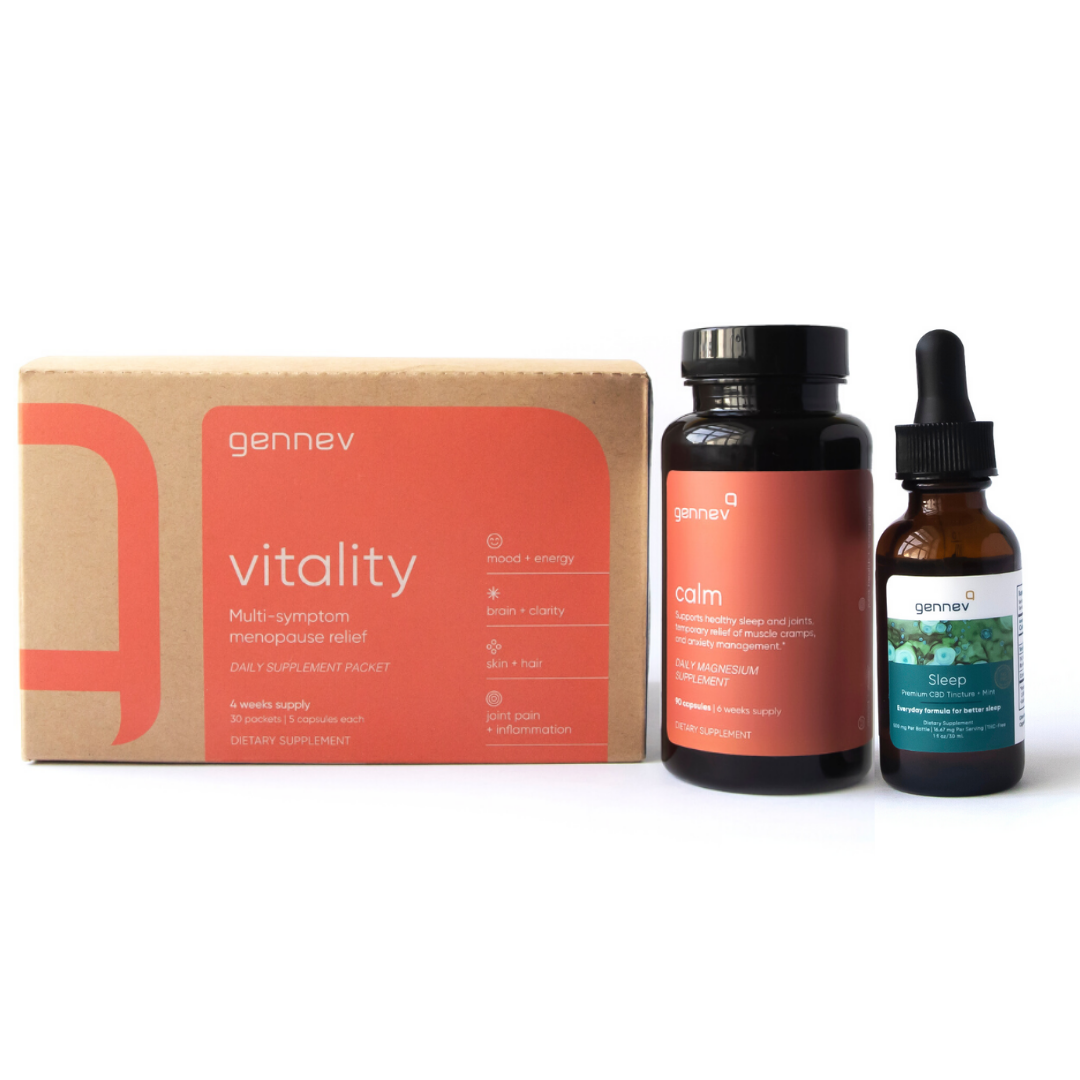
Are you craving the energy you used to have? Taken as part of your morning and bedtime routine, the AM/PM Daily Menopause Pack helps restore energy during the day and brings a peaceful sleep at night.
In the morning, take the Gennev Vitality multi-vitamin between breakfast and lunch to fight afternoon fatigue, regulate mood, and provide whole-body nutrition that can help bones, hair, and nails. Women rave about this new multi-vitamin formulated for women 40+. As one satisfied Gennev Vitality customer said: “I am not a vitamin person…never have been…. Vitality has been amazing. I have been taking them for over a month and I’ve never had an upset stomach – even if I don’t eat much in the morning first. I also don’t like to drink a lot of caffeine but I do feel tired in the afternoon but after taking Vitality I don’t get that afternoon energy slump.”
At night, add the Sleep CBD + Melatonin softgels and Magnesium Glycinate to your bedtime routine to help you get more rest at night. You’ll wake up feeling refreshed and free of morning anxiety. Our bodies naturally make melatonin, but as we age, we make less. Gennev Sleep CBD + Melatonin supplies just the right amount to help you fall asleep fast and stay asleep peacefully. With the natural stress- and pain-relief many get from CBD, the softgels are a powerful sleep aid that do not create dependency or the “boomerang” effect of worsening sleep you can get from OTC sleep aids.
Each of these products and can be purchased separately, but if taken together, you get the benefits of them working in harmony to help you feel your best. The AM/PM Daily Menopause Pack is priced at $89.95 for a 30-day supply (which equals a 10 percent savings on all products when purchased as a system).
Gennev Sleep System
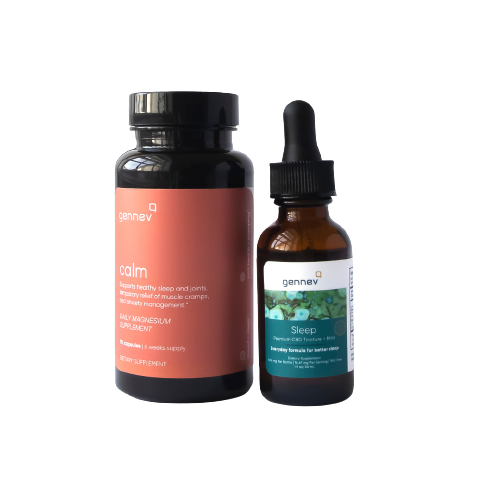
So. Many. Women are affected by interrupted sleep in perimenopause and menopause. And lack of sleep can make a very challenging time even harder to manage. So the Gennev Sleep System takes on all the reasons women aren’t getting good rest.
Sleep CBD Tincture absorbs quickly through the tongue so you fall asleep faster. Our Tincture is THC-free and can be used safely with kids, pets, and older adults without fear of getting “high.” The organic peppermint essential oil gives it a nice, refreshing flavor.
Magnesium for sleep is another natural aid, but up to 80 percent of us don’t get enough of this powerful nutrient. It can also relieve joint pain and menstrual cramps and relieve the morning anxiety many women experiences.
The Gennev Sleep Challenge addresses many of the other reasons women have trouble sleeping: food and drink choices, hydration, stress, movement, and more. Daily, users receive a text tip to their phone, helping them practice good sleep hygiene for natural sleep improvement.
Purchased together as the Gennev Sleep System, you get the compounding effects of these products working together. And, priced at $56.96 for a 30-day supply, you get a sweet 10 percent discount compared to purchasing the products individually.
Gennev Menopause Dryness Care
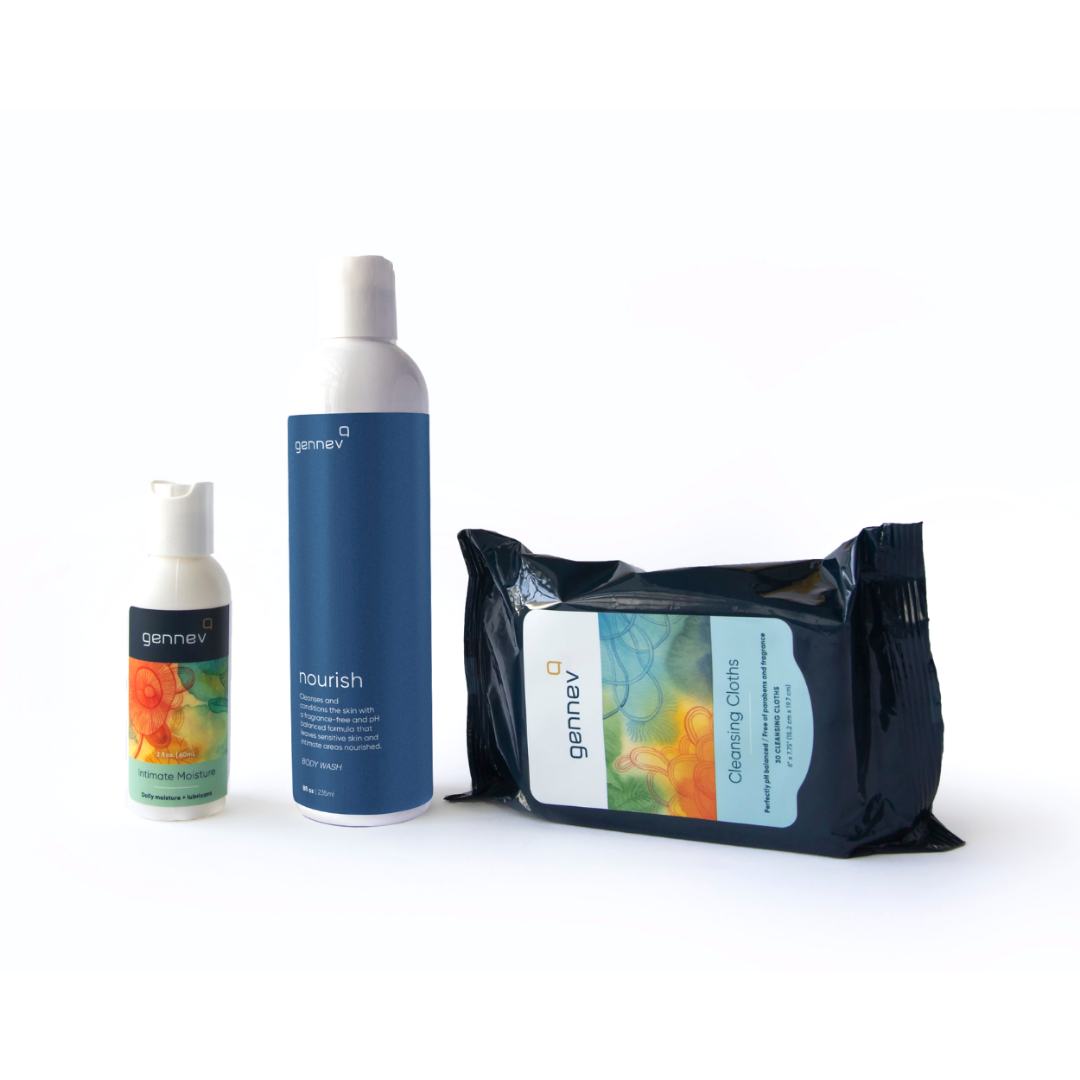
Are you craving better sex? Feminine dryness can really ruin the moment. Formulated by OB/GYNs and naturopathic doctors, the Gennev Menopause Dryness Care system soothes vaginal dryness. Gennev’s Ultra-Gentle Body Wash gently cleanses and balances the pH of a woman’s intimate area. Gennev’s Intimate Moisture feels and functions like a woman’s own moisture to relieve feminine dryness instantly, enhance intimacy, and help with painful sex. And the aloe-infused Cleansing Cloths are a fabulous way to freshen up afterwards or on-the-go.
These products used together work more effectively to ensure you feel like your old self down there, and we’ve priced the Gennev Menopause Dryness Care system at $34.95 for a 30-60 day supply, so you get a better value as well!
Why “systems”?
The Gennev systems were created for a number of reasons:
- Simplicity = consistency. For most menopause solutions, it takes time for your body to adjust and really feel the benefits. If you’re not consistent using the product, that time can be even longer and the benefits more gradual. We want you to feel the goodness as soon as possible, so making sure you have a good supply of everything you need makes that a whole lot simpler. (Hint: a monthly subscription that lets you set it and forget it is even better for helping you stay consistent, not to mention the additional discount.)
- Evidence-based research. Our systems were created using treatments that truly complement one another, like combining magnesium glycinate and CBD for better sleep. It’s the definition of synergy: combined, the effects of each solution are even greater. We have a whole team of medical professionals weighing in on the best combination of products for symptoms, so you don’t have to do the research!
- Price/footprint. When we can send products packaged in one shipment, you save money, we save money, and we use less packaging, which helps save the planet’s resources.
As women buy products, we learn what you need, and as women provide feedback on the systems, we’ll continue revising and improving our offerings. Please pass along feedback to info@gennev.com.
So, about that “magic pill” for menopause “¦
For many women, HRT can do a lot to alleviate menopause issues, so explore it as an option if you’re a good candidate. If HRT isn’t right for you, your “magic pill” for menopause might be more of a “magic packet.” But that’s OK. Our systems can help you put a lot of things right and manage your menopause in a new and healthy way.
Authored by Gennev Chief Medical Officer, ob/gyn Dr. Rebecca Dunsmoor-Su.
“There’s been yet another round of lay-press headlines about how estrogen plus progesterone hormone replacement may increase the breast cancer risk,” says OB/GYN Dr. Rebecca Dunsmoor-Su.
Headlines don’t tell the full story, and Dr. Dunsmoor-Su, who is an epidemiologist as well as an OB/GYN, helps us separate fact from fiction in this podcast.
If you’re dealing with menopause symptoms and are worried about taking HRT to manage them, you’ll want to give this a listen.
TRANSCRIPT:
Hi, this is Dr Rebecca Dunsmore-Su, the Chief Medical Officer here at Gennev. I wanted to put together a podcast today about hormone replacement therapy [HRT] and breast cancer.
I’m addressing this again because there’s been yet another round of lay-press headlines about how estrogen plus progesterone hormone replacement may increase the breast cancer risk. And that’s because of some data presented at a breast conference recently.
It’s important to note that this data is not new data. It is the same data from the Women’s Health Initiative that we’ve been talking about for many, many years. And the data from that study has been analyzed multiple times by multiple other investigators, and they all note that the data does not really show an increase of breast cancer in this population.
When you actually parse the data out and look at the women who started estrogen and progesterone and have had never seen hormone before and therefore likely younger and more close to the time of transition of menopause, there is no difference in breast cancer rate between them and people given a sugar pill in the same group.
Importantly, the only group in which they found a difference between them and the sugar pill is in women who had taken hormones before and stopped.
Two big issues with that: One, that’s not how we use hormones, and two, the group given a sugar pill in that subgroup actually had a much lower than average rate of breast cancer. So in comparing those two groups, you’re actually comparing to the wrong comparative group.
If you look at that group of women given estrogen plus progesterone, they really actually don’t have a higher rate of breast cancer than any other E plus P group that we’re not calling significant.
That’s a lot of statistics talk for saying if you work with your data enough, you can make something look like it causes harm. But really when you look at how we use hormones, estrogen plus progesterone really does not increase the risk of breast cancer.
But again, some studies say it does. Some studies say it doesn’t. Some big studies say it does. Some big studies say it doesn’t. And why are we seeing this back and forth? Why don’t we know the answer by now?
I think there are two real reasons why that’s true. The first reason is, in anything that may have a very small or no impact, if you do studies you’re going to see studies give you false data on both sides of that true estimate. It’s why we do large studies. It’s a statistical anomaly and so what we’re getting is all of these studies on either side sort of telling us, well maybe the reality is somewhere in the middle or somewhere around zero.
The second reason is probably genetic. Not all women are the same and we know from some studies that there are gene products that probably make it an increased risk to take hormones and with breast cancer and we know from other studies that there are women for whom taking hormones can be protective against breast cancer.
The problem is we just don’t know all of the genes that can impact this yet and so you’re going to see different responses from different women to hormone replacement therapy. The one thing I do know is that no matter which side of that genetic line you fall on, the actual overall impact of hormones on breast cancer is probably exceedingly low.
So what, you may ask, does that mean for you? Well, here’s how I approach hormone replacement therapy. I approach it by saying, well, what is it good for, and what could the risks be, and how do I balance those for my particular patient?
Benefits of hormone replacement therapy
So first of all, what is hormone replacement therapy good for?
Number one, it’s good for symptoms. If you are suffering significantly from hot flashes or night sweats or vaginal dryness or any of those symptoms, hormone replacement therapy is actually very a effective medication for that, and only you know how big the impact of those symptoms are on your life and how much you would value taking a medication that can make them go away.
The second thing we know it’s very good for is your bones. It’s one of the best medicines for preserving bone strength. We don’t typically use it just for that, but we certainly as providers understand that it does one of the best jobs with the least risk for protecting bones.
The third thing I’ll talk about with people is cardiovascular protection from hormone replacement therapy. The answer to that is very complicated and again, women are genetically very different. So there’s no one answer for each woman. But we do know that women who have estrogen have a different lipid profile and a different cardiac risk in terms of heart attack than women who are menopausal.
And so there is probably some protective effect from that perspective. But depending on how you use the hormone, it can also be dangerous because if a woman has already developed atherosclerotic plaques in her arteries, adding estrogen back can cause blood clots to form on top of those and could probably increase her heart attack or stroke risk.
So when you’re talking to a doctor about hormone replacement therapy and cardiac risk, you need to be having a very complex discussion about whether it might be beneficial or harmful for you.
The next thing that we sometimes use hormones for is mood, and in some women it really can be quite beneficial in balancing mood, especially in the perimenopausal time. However, we don’t have great evidence that it helps all women. And again, this is likely because women respond differently both to hormone and have different reasons for having mood symptoms.
And the last things women often ask me about are more what we typically think of as superficial things like their skin, their hair, their nails, and their weight gain. Hormones can be somewhat beneficial for those things, but I certainly don’t start women on it just for that because really its impact is quite low in those things and there are other things that are safer that we can use for that.
Risks of hormone replacement therapy
So if those are the things hormone replacement therapy can be good for, what are the risks? In my mind, the biggest risk is actually for blood clotting.
So we know that estrogen increases the risk of forming a blood clot in the body. We know that women who are pregnant have a higher risk of that. We know that women before menopause have a higher risk of that. It is a known risk of estrogen. It is not a huge risk.
The baseline risk of forming a blood clot if you don’t have a predisposition is quite low and the increase is relatively small from adding estrogen. But we do talk about it because it can be an important risk, especially in people who might be at higher risk of stroke. So it’s important to think about that risk and whether it applies to you.
The second thing we talk about when I counsel patients is breast cancer, and I tell my patients honestly I don’t think that estrogen really, on the whole, increases your risk of breast cancer. I think there are certain people for whom that might be true and there are certain people for whom it’s protective. But on the whole, for most women, it’s probably not a big risk.
The important thing to keep in mind also is one of the things they show in the Women’s Health Initiative that we don’t talk about a whole lot and in some of these other large studies is that when women do get breast cancer on hormone replacement therapy, it’s often a lower grade or earlier-stage cancer and easier to cure.
The last thing I always talk to my patients about is that one in eight women will get breast cancer in their lifetime. That’s your baseline risk, so it can be really hard to tell if something is actually increasing that risk when the risk is so common. And while breast cancer is very scary to us as women, we think a lot about it, in reality, it kills very few of us, and those of us who are at highest risk of dying from breast cancer and breast cancer complications or those of us getting it at earlier ages, and there’s a lot of genetic interplay with that.
The sort of breast cancer that we see as women age that contributes to the large portion of this one-in-eight risk is generally caught fairly early stage — if you’re getting adequate screening — and is curable.
Many, many, many more women will die of cardiovascular disease and many, many more women will die of hip-fracture related complications. So we need to be thinking and talking much more about cardiovascular disease and bone health in women in menopause.
Taking HRT safely
So I just gave you my counseling session that I give to women in my office for hormone replacement, and many of them after that counseling session say, well, what would you do? Or what should I do?
And I tell my patients that if you’re going to use hormone replacement therapy, which I often recommend, you need to be using it safely, and the most important thing you can do is know what you are taking.
I see many women in my office who have been told by other providers that they can be given a special, compounded, just-for-them hormone replacement, that will be better than anything made by an evil pharmaceutical company.
This is not true.
First myth: there is no “natural” hormone replacement. Estradiol and progesterone are synthetically made. If you get it compounded, it’s still synthetically made in the same pharmaceutical company that made the pills that I would prescribe you or the patches that I would prescribe you.
Second, no one can match it to the hormones that you had before menopause because those hormones are gone. We can’t predict what those were. So anyone who’s saying they’re making a blend especially for you really isn’t. They’re just making a blend that they’ve been taught to make.
And the third big thing that I tell people is when you are getting things mixed into creams or rubbing them on your skin, you do not know what dose you are taking. While they try to do their best to get it evenly mixed throughout that compounded cream or lotion or base, it is not evenly mixed and we know it’s not. And when the Lin tests have been done on these products, the variation in the amount of hormone actually in any given dose is quite wide. If you’re going to take something that might have a risk, you need to be taking something where you know what dose you’re getting.
And so I tell my patients, I only use the pharmaceutically generated and regulated products such as estradiol pills, estradiol patches, and progesterone pills and things like that. And that’s just for safety’s sake. If there might be a risk associated with this thing, I at least want to know what I’m giving you.
The second thing you can do is get your breast screening, get your mammograms, get your breast exams at the doctor. People don’t enjoy getting mammograms. Trust me, I don’t enjoy getting them either, but they are our best method of screening for early-stage cancer, and if we catch breast cancer early, it can be cured.
The third thing you can do is when these articles come out in the lay press, read them with a critical eye. Many headlines are generated to scare so that you’ll read the article. So just be aware there may be no new data behind this. They may just be rehashing the same data that we’ve heard over and over again, trying to get a new article out of it.
The fourth thing I tell people is, help us to understand better how genetics play into breast cancer risk and hormone. Go to an organization like MiraKind.org, and there’ll be a link on our website for this. That is a nonprofit organization that’s doing genetic research on how different gene factors play into the breast cancer risk in women. And it’d be great to sign up for one of their studies if you qualify.
And finally, when you’re thinking about using hormone replacement, find someone with genuine credentials, find a physician who has some training in menopause and really understands the issues behind this and doesn’t automatically do the same thing for every woman.
This should always be a discussion between you and your doctor and they should have a good understanding of the risks and benefits of hormones and be able to explain that to you and make a tailored decision for you.
Thank you so much for listening. I know this is a constant question and issue for us here at Gennev. And our goal, as always, is to give you the best, medically valid and evidence-based information we can find.
Join the conversation that continues on about HRT, breast cancer, all things midlife and menopause, and more in our Community forums. You are always invited.
So, last night you had popcorn and a Dr. Pepper for dinner.
Not exactly the most balanced meal, but you were hungry, it was too hot to fire up the oven, popcorn has”¦well, at least fiber, right? Could be worse.
Could also be better. But we get it: not every meal is going to be as nutritious as we might hope. And that’s OK. But chronically falling short of nutritional guidelines really isn’t great for your health, and many adults (particularly older women) don’t get enough of some pretty important nutrients.
So maybe you decide to take supplements, just to ensure you’re getting enough of everything you need.
During your weekly grocery shop, you venture into the “vitamins” aisle, take one look at the groaning shelves stocked to bursting with a million options, and back right out again, determined to eat more kale.
So let’s talk about how to buy supplements.
In this blog, we’re not going to discuss which nutrients you need (but you’re getting enough magnesium, right?). For now, we’re more concerned with how you choose supplements for menopause symptoms that are safe and effective.
Why is supplement safety a problem?
In the US, supplements are a multi-billion dollar industry. But because the government considers supplements to be more like food than like medicine, the regulation of supplements is far less rigorous than on drugs.
Why does it matter? Because safety. Drugs must prove they are safe before they can go on the market as via trials under well-controlled conditions. Supplements are considered “safe” until someone proves the supplement has caused harm.
With so much potential profit and so little regulation, it’s a great opportunity for the unscrupulous to prey on consumers, offering “supplements” that may do nothing as or may cause more problems than they solve.
Potential risks include:
- Misleading labeling. A studies found that after many herbal supplements were tested, less than half contained the herb claimed on the label.
- Because the supplements aren’t checked by 3rd parties, unscrupulous providers may use fillers or allow contaminants into the supplements.
- “Extra ingredients.” In order for their “supplement” to meet the company’s claims, some have added medications such as steroids or other drugs. These are not generally listed and can cause dangerous interactions or carry health risks of their own.
- “New ingredients.” Untested ingredients have found their way into supplements, causing “ in the case of DMAA “ several deaths.
- Just because something is natural doesn’t make it safe. (Box jellyfish are “natural” too, but you wouldn’t give one to your kids as a pet.) Some herbs can interact with medications, either making them less effective or putting your health at risk. If an ingredient isn’t listed, or risks aren’t added to the label, you could unknowingly put yourself in danger.
How do we choose safe supplements?

To figure out how to find credible sources among the vast quantities of supplement providers, we turned to Dr. Wendy Ellis, Naturopathic Physician and educator.
Want safe supplements? First, says Dr. Wendy, check that the supplement’s manufacturer followed the cGMP “ Current Good Manufacturing Processes “ and that they’ve been certified via a third party audit. You should see an endorsement like this one on the supplement label.
The cGMP are set by the Food and Drug Administration (FDA) and are “a set of requirements that ensure the quality and safety, including the testing, manufacturing, preparation, storage, and other quality assurance procedures. This ensures that the dietary supplement is packaged and labeled as specified in the master manufacturing record.”
Next, Dr. Wendy says, be sure the company has and follows specifications for all raw material and finished products. Meaning, they know where their ingredients come from and how they’ve been handled. They should be able and willing to provide documentation of this on request.
Third, be sure the manufacturer tests regularly for potency and to ensure against contaminants. These include solvents used in manufacture, heavy metals or pesticides that can be picked up in when ingredients are being grown, and pesticides and molds, as herbs and other food products can be at high risk for these.
Finally, the manufacturer should be able to guarantee that the product will remain safely stable and potent throughout its shelf-life.
There are several reports that may help you determine some good supplement manufacturers.
Here’s To Better Vitamin Safety
Obviously, it’s tough to get all this information on the label, so you may have to call the manufacturer or do some research on your own. But it’s worth it to be certain your supplements are safe and of good quality.
The health care world is still undecided about the effectiveness of supplements, but from our own experience and those of the women we work with, we know many supplements have had life changing (and menopause surviving) benefits. If you do decide to add to your diet with supplements, please do so safely, and check with your doctor to be sure supplements won’t interact with your medications.
Do you take supplements to complete your nutrition? How do you choose the ones you take? We’d love to learn more from you, so please comment below or join in the discussion on our community forums!
Thank you to Dr. Wendy Ellis, Naturopathic Physician and educator for her advice on choosing safe supplements.
What if we said you could improve your balance and maybe reduce urinary incontinence (leaking) as at the same time?
Menopause and falling
September 22, 2018 is Falls Prevention Awareness Day, according to the National Council on Aging. A study by the National Center for Health Statistics and the Centers for Disease Control and Prevention (CDC) found that falls are the most common cause of non-fatal injuries to women. While the Council is looking primarily at seniors, even younger women in menopause are more prone to falling than their pre-menopausal sisters.
Falls happen “ a lot “ and can cost us a lot more than dirty clothes and wounded dignity. According to Sixty and Me, “Roughly 1 percent of older Americans who experience a fall will die as a result of this fall. This amounts to approximately 32, 000 deaths per year or just under 90 deaths per day due to falls.” So it’s important to take the issue seriously.
Why? Well, loss of estrogen weakens muscles, and it can also affect a woman’s inner ears, which are critical to our sense of balance. Additionally, our proprioception as our conception of our body’s place in space as can be a bit untrustworthy during this time.
Given how common falls are in menopausal women (and how serious they can be, thanks to the weakened bones of osteoporosis), we thought we’d talk to our amazing PTs, Dr. Brianna Droessler-Aschliman and Dr. Meagan Peeters-Gebler, for advice on how to stay upright and in balance.
Better balance “¦ and a bonus
Turns out our pelvic experts had even better information than we expected!
Incontinence often occurs or worsens during perimenopause and menopause, Meagan reminded us, and here’s where things get interesting: because urinary continence and balance both rely on core muscles, solving for X may also mean solving for Y.
When this topic came up, Meagan decided to do some digging into the question of balance and incontinence. Is balance different in women who leak?
Answer: yep. The question, as far as the pelvic floor is concerned, is the center of pressure. You want your body to be in good alignment so the pressure on the pelvic floor is distributed evenly, including when your bladder is full. In women who leak, that center of pressure is displaced as not in alignment as and the uneven distribution may be part of what causes incontinence.
Women who don’t suffer from incontinence tend to have a more even distribution of pressure and experience fewer issues with balance.
Solve for X, solve for Y.
Breathing also plays a role here, so hang in with us for a second, it’s a bit complicated. Your inner ear gets input from your body on your position: sitting, standing, lying, stable, wobbly. That system communicates back and forth with your core and pelvic muscles (among others), making adjustments to keep you upright and in balance. It also communicates with your diaphragm, which is a muscle at the top of your core that regulates breath.
We know that breathing incorrectly can negatively impact your pelvic floor, so it’s important that your inner ear gets the right information to feed to your diaphragm.
Right breath, right balance, right alignment, right use of core muscles equals fewer falls and less tendency to leak. Ta da!
So, knowing all this, what do we do now?
How to fix it all?
There are a lot of factors involved in falling: your muscles, your proprioception, your environment. The best way to protect yourself from falling is to tackle them all.
Muscles
Integrate your pelvic floor in your work on balance, say our PTs. There’s a chicken-and-egg effect here where working on your pelvic floor may take some of the burden off lower stabilizer muscles in your feet and ankles, and working on greater strength and flexibility in feet and ankles may take the burden off your pelvic floor.
Stronger and more flexible feet and ankles. The muscles of our feet, particularly on the inside, are critical to our negotiation with the surface below us. The demand is different if we’re walking on a smooth sidewalk or a rooted and rocky forest trail. Our feet and ankles should be strong enough to catch us when the surface suddenly changes. If they’re not, the burden of correcting posture has to travel up the chain to hips and core.
Correct pelvic floor issues. Work with your PT or do your kegels to keep pelvic floor muscles fit. Having a strong core enables you to catch yourself should you start to fall. Also, Brianna reminds us, a stronger pelvic floor means less urinary urgency and fewer trips to the bathroom in the night. “Women who have to rush to the bathroom are at a much higher risk of tripping over the rucked up carpet or their cat,” says Brianna, “and I probably see the most falls from women who are sleepy, moving around their house in the dark, to go to the bathroom. If we can take you from three or four trips per night to one or none, your risk of falling goes way down.”
Balance and Proprioception
While the effects of estrogen on your inner ear are largely out of your control, you can train your body and brain to be more aware of your position in space. Tai Chi, yoga, and basic balance exercises can help you get stronger, be more in control of your movements, and be in better balance.
Also, learn the right way to regain balance when you go a bit wobbly. “We’re afraid to fall, so we immediately reach out our hands,” Meagan says. “But the wobble is your body doing what it’s supposed to do, it’s correcting. Take the big step; lift your foot as use the body’s built-in ways to catch itself.”
Environment
Be aware of tripping hazards, both PTs agree. Make sure throw rugs are taped down, pick up dog or kid toys, throw out those slippery piles of magazines. If you do have to get up in the night, illuminate your path with some dim nightlights. Have the right footwear for the occasion: Yaktrax on slippery sidewalks, good boots for hiking or rough trails, save the heels for the office. “Slow down!” says Brianna. “When you’re moving, put away your phone and pay attention to your environment. One of my patients reads the newspaper while walking. Aaaaaaand that’s why he’s a patient.”
So on Falls Prevention Awareness Day, we challenge you to take a moment to minimize your risk. Check your environment for hazards. Light the way from bed to bathroom. Check into a tai chi group at your local park, or just do a few kegels as you’re finishing up this blog and emailing it to a friend. Your bones, your brain as and your bladder as will thank you.
Have you dealt with balance issues or suffered from a fall? Share with us in the comments, talk with us in the Gennev community forums, or share on Gennev’s Facebook page or join Midlife & Menopause Solutions, our closed Facebook group.
Menopause is possibly the world’s worst-kept secret.
Half the world’s population goes through it, and yet many women we talk to are shocked to learn the headaches, anxiety, weight gain, insomnia, tingling fingers, restless legs, hearing loss, and rage they’re experiencing may all be symptoms of the perimenopause/menopause phase of life.
And that those symptoms can start as early as their mid-30s.
“I thought one day my period would just stop, maybe I’d have a few hot flashes and that was it,” one Gennev community member told us. “I had no idea how much menopause would impact every aspect of my life.” It’s a sentiment we hear again and again and again.
It’s a “challenging” time. And not knowing what to expect or how to handle it can make matters so much worse. We want the current group of transitioning women to be the last group to be mystified, embarrassed, scared, and overwhelmed by menopause. At team Gennev, we want women to have a healthier, happier, easier menopause as and we’re helping make that happen.
Midlife shouldn’t be something to dread. It’s a great, vibrant time of life when women feel freer, more independent, more creative, stronger, bolder, more themselves than they’ve ever felt before.
If you’re ready to step into your vibrant, glorious midlife, or if you’re there and want to share, we hope you’ll join us at an amazing occasion: the M event by Gennev.
What you’ll learn at the M event
On November 10, we’re gathering the foremost practitioners in women’s health to share their latest work across subjects like hormones and sex, brain fog and Alzheimer’s, cardiovascular health and skin health, cancer and aging.
We have an amazing lineup of experts to help you thrive through the transition and beyond:
Dr. Rebecca Dunsmoor-Su, MD MSCE, Board Certified Ob/gyn and Owner and Lead Physician, RenuvaGyn; Director of Health, Gennev, will take on the topic of “Vaginal health and sexual dysfunction.”
Dr. Lisa Mosconi, Neuroscientist, neuro-nutritionist, and Alzheimer’s researcher, Weill Cornell & New York Presbyterian, Author of Brain Food, The Surprising Science of Eating for Cognitive Power, will talk about “The link between estrogen, menopause, and Alzheimer’s risk.”
Dr. Sarah Speck, MD, Medical Director of Swedish Heart and Vascular Institute, Owner of Speck Health and co-founder of POTENTRx, will address “Heart disease risk after menopause.”
Nicole Negron, Certified Women’s Health, Nutrition and Lifestyle Consultant on female brain chemistry and hormonal health, will speak on “Weight, hormones, and the cycle of life.”
Dr. Arianna Staruch, Naturopathic Doctor and Dean for the School of Naturopathic Medicine at Bastyr University, will tell us about “”Naturopathic Support for Women in the Menopause Transition.”
Dr. Keira Barr, Certified Dermatologist and Chief Wellness Officer, Resilient Health Institute, Author of The Skin Whisperer, will discuss “Let’s get naked: Are you listening to your skin?”
Attendees of the event will have the opportunity to get even more information from our speakers during a live Q&A.
But wait”¦ there’s more!
The event will be held on the grounds of beautiful Bastyr University. We’ll enjoy a light breakfast and delicious lunch provided by their catering staff.
During breaks and at lunch, participants will have the opportunity to check out our expo, where vendors are showing and selling products and services tailored to the midlife woman.
After lunch, there will be a small-group session facilitated by Nancy Board, Co-Founder and COO at Global Women 4 Wellbeing. Group members will do a deep dive into “Menopause, hormones, and rage.”
Because we want women everywhere to have the opportunity to learn more about their bodies, their health, and their futures, the M event will be live-streamed on the day and available on-demand after. To get access to the free live-stream or on-demand, register for the event, and under “Tickets,” choose the “live stream” ticket option.
Giving back
Gennev is proud to be a Founding Member of Global Women 4 Wellbeing; 10% of all ticket sales will go towards women’s health and well-being research through GW4W’s global work.
How to register
Participation in the small group event is limited and available on a first-come-first-served basis. If you’re interested in participating in the small group, be sure to select the correct ticket on Eventbrite. Remember, to get the link to the free live-stream and/or on-demand versions, you’ll need to register, choose “Tickets,” then select the free live-stream option.
The details
The M event will be held Saturday, November 10, 2018, 8:00 AM as 2:00 PM PST at Bastyr University in Kenmore, WA.
Our non-profit partner

Our sponsors
Our Media Partners